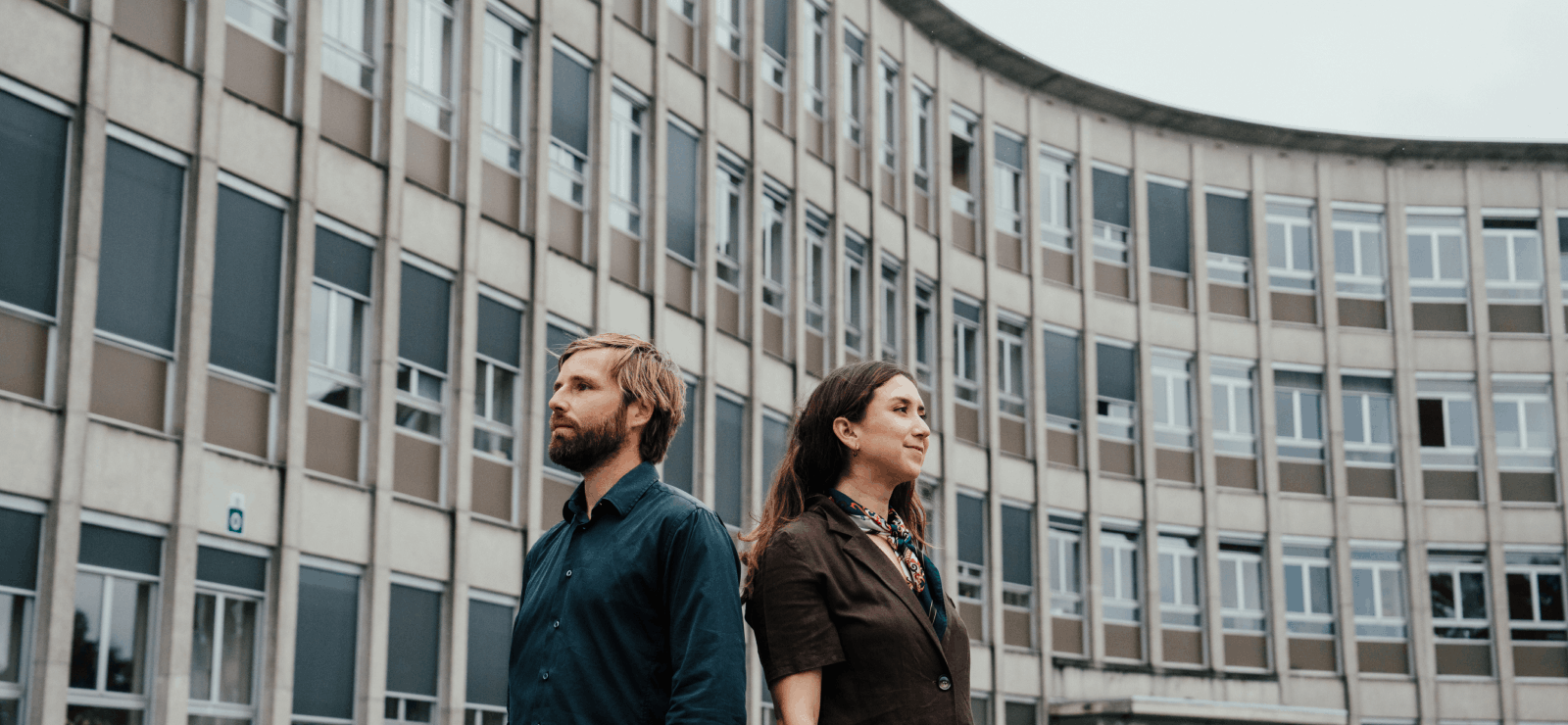
Master's student Dayana Garzón swapped the Ecuadorian Amazon for Ghent University. Here, she turns her passion for sustainability into concrete solutions under the guidance of Professor Thomas Hermans. “With basic knowledge of land and water use, you can save lives.”
Dayana Garzón sits down with a wide smile in the office of professor and geophysicist Thomas Hermans (Faculty of Sciences), although she immediately admits to feeling a bit tired. Her parents visited Europe for the first time this past summer, and together they went on a road trip through Madrid, Rome, Paris, and the Belgian coast, among other places. “Once you’re in Europe, you naturally want to see everything,” she laughs. In addition to this trip, Dayana stayed busy this summer by doing an internship with the Flemish government. In September, she begins her second master's year. Now that her luggage is packed away, Dayana's focus is fully back on her studies at UGent.
Dayana comes from the Amazon region in Ecuador, where she studied at the Universidad de Cuenca. Through a scholarship, she is enrolled in the Master in Sustainable Land Management at UGent. “During my bachelor's degree in civil engineering, I took an elective course on sustainability and fell in love with the topic instantly. When I spoke to my professor, who also has strong international connections, he pointed out this specific program at UGent,” she explains.
What is Sustainable Land Management?
This English-taught master’s program is organized by Ghent University, VUB (Vrije Universiteit Brussel), and various international partner universities in Asia, Africa, and South America. The program teaches students how to sustainably manage our precious soil and (ground)water reserves. The focus lies on solutions for global environmental and climate challenges in terms of land and water use.
From water issues in the Amazon to extreme drought in Ethiopia
The program attracts students from all over the world, particularly from the Global South. “Every region faces its own specific challenges: from saltwater intrusion into coastal freshwater sources in Vietnam, to extreme drought in Ethiopia,” says Thomas Hermans, coordinator of the program. “We teach our students knowledge that they can apply anywhere; we don't expect a specific career path from them.”
Dayana adds: “That is precisely what makes it so great: the content of this master’s program is a huge enrichment for many other fields, like mine in civil engineering. For example, I learned about groundwater management and dredging techniques here—things I had never heard of during my bachelor’s in Ecuador.”
The importance of international fieldwork
Thanks to these global partnerships, lecturers and students can conduct international fieldwork every year, such as in Indonesia this year.

“We teach our students knowledge that they can apply anywhere; we don't expect a specific career path from them.”
This exchange of knowledge strictly goes both ways. Not only do UGent students head abroad for internships, fieldwork, and master’s thesis research at partner universities, but several course components at UGent itself are taught by lecturers from partner institutions. For instance, the remote sensing course is taught by a guest lecturer from Vietnam, and other courses are co-led by colleagues from partner countries.
Thomas considers the importance of international fieldwork undeniable: “This approach leads to tangible results. For example, a few years ago, a master's student from Panama researched a specific water basin that had hardly been studied before, amid growing concerns about the impact of ore extraction on those water supplies. Her research showed that the supplies were still safe. She is now back in Panama working at a research institute, where she applies that knowledge to other water basins.”
For Thomas, participating in such an international project changed his perspective on science. “As an early-career researcher, my focus was on theoretical research. It wasn't until I worked in Vietnam on concrete measurements of contaminated drinking water that I realized how basic knowledge can directly improve—and even save—people's lives.”
Welcome to Flanders
Although many students return to their home countries after completing this master's program, some deliberately choose to stay in Flanders. Thomas emphasizes that this is very welcome: “Flanders lacks sufficient experts in water management. The current number of graduates is inadequate. Therefore, we urgently need international researchers.”

Dayana also doesn't rule out a longer stay in Europe. “My home region in the Amazon has huge water resources, but they aren't managed well. Because of the vast freshwater reserves in the region, no one pays attention to groundwater. Being in Europe might even allow me to do more for my country—for instance, by setting up international projects and collaborations—than if I were there on the ground.”
Meteorites and drones in Antarctica
Her master’s thesis, for example, focuses on meteorites and drones in Antarctica: a subject that is worlds apart from her background in civil engineering and water management. “It’s something completely new to me, but incredibly fascinating. I’ve learned here to stay open to entirely new fields of knowledge instead of staying strictly within my comfort zone. My goal for the coming year? To get everything out of it that I possibly can.”
September brings fresh energy for Thomas as well. “It’s fantastic to finally put faces to the names on those paper applications. Our goal, of course, is to help all these students graduate and make an impact on society as a whole.”
What tip would you give UGent students for the upcoming academic year?
Dayana Garzón: “Have fun, but keep your larger goal in mind. Take your studies seriously from day one and don't wait until the exam period to start studying. It will make your student life a lot easier in the long run.”
Thomas Hermans: “Find a relaxing environment every now and then. Enjoy Ghent, but explore other regions of Belgium too. My personal tip: head to the Ardennes. It almost feels like being in another country
Read also
How Campus Kortrijk Connects People and Technology
UGent Campus Kortrijk maakt zich op voor een academiejaar vol creatieve ideeën, duurzame innovatie en warme ontmoetingen. Een dubbelgesprek over inclusief ontwerpen en de kracht van diversiteit. “Culturele verschillen kunnen mensen juist dichter bij elkaar brengen."

Italian researchers Leonardo and ‘buddy’ Victor are pursuing their PhD at Ghent University: "Belgium is more relaxed"
Moving to another country for your job is a big step, but two researchers from Italy quickly found their footing in Ghent. “I love your red bricks.”

Gentrepreneurs on the buzz of entrepreneurship: “If I can help students, I’ll consider the year a success”
Thinking of starting a business as a student? Emilia De Graeve and Hannes Van Cauwenberghe would recommend it to anyone. Emilia, a psychology master’s student and co-founder of Blokmap, and Hannes, an alumnus of Ghent University and founder of several companies, take a moment to reflect on their lives as Gentrepreneurs. “Ghent University only makes your ideas more outlandish.”

Purifying water helps both companies and the planet move forward
Companies, farmers, nature and consumers alike depend on water. Yet despite the fact that 70% of the Earth’s surface is covered with water, only 1% of it is drinkable. And as climate change progresses, ensuring sufficient water for everyone is becoming increasingly challenging. Advancing water purification technologies is therefore more essential than ever.
