January often starts with good intentions… but those plans can be quickly abandoned. To exercise more is always high up everyone’s list, but there’s often a gap between wanting to do it and actually doing it. So how do you bridge that gap?
Eline Lievens and Wim Derave, exercise physiologists at Ghent University, explain how in their book De Beweegreden. Their message is simple: not moving is bad for your health, but small changes can lead to big health benefits. We asked Eline some practical tips to help you stick to your exercise goal in 2026.
Why moving too little is such a problem
We live in a world that encourages us to sit. But our bodies weren’t designed for that. Our physiology still resembles that of our hunter-gatherer ancestors, who moved constantly. Since the industrial revolutions, we’ve become less and less active, and today, sitting still has become the norm.
And yet moving your body acts like a broad-spectrum medicine: it helps you stay healthier for longer and lowers the risk of chronic diseases such as diabetes, obesity, dementia and cancer. “Physically active people are about 40% less likely to die prematurely,” says Eline Lievens. “What medicine can compete with that?”
Still, as a society, we focus far more on treatment of illnesses than preventing them. “Belgium currently spends 98% on curative healthcare, where treating illness is central. Only 1.8% of health spending goes to prevention.” That’s completely upside down.
Moving too little isn’t just a matter of personal responsibility. “We teach kids to brush their teeth, but that’s where it stops,” says Eline. “In reality, school curriculums should include a subject about how to keep body healthy?”

Eline Lievens: "As a society, we need to invest in environments that make movement easy: safe cycling paths, schools and shops nearby, and local recreational facilities.”
“And as a society, we need to invest in environments that make movement easy: safe cycling paths, schools and shops nearby, and local recreational facilities.”
It is about more than just sports
Many people still think in black-and-white: either you’re a “serious” athlete, or it doesn’t count at all. Eline: “But your muscles are not aware about the difference between climbing stairs or sprinting on a football pitch. When you move and your heart rate goes up, something happens.”
That’s why “moving more” entails more than simply “doing more sports”. It's also about active travel (cycling to work), movement at work (taking the stairs), and being active at home and in your free time (vacuuming, gardening, walking).
The good news: people who currently move the least can get the biggest gain. Eline stresses that going from roughly 4.000 to 7.000 steps a day already comes with a lot of health benefits. So you don’t need to wait until you reach 10.000 steps a day. Want an extra boost? Add something more intense in the mix: climbing three flights of stairs has more impact than walking to the coffee machine.
Movement is fuel for your brain, too
Moving doesn’t only affect your body, it also affects your mind. Many people notice they feel more clear in the head after exercise. “When you move, the prefrontal cortex gets more blood flow. That helps you concentrate better and make stronger connections, like a brain boost. Research shows you perform better on a maths task after you've briefly moved compared to doing it after sitting still.”
There’s something else at play as well: “When you move, your muscles release substances called myokines that also influence the brain. Normally, the volume of the brain’s memory centre shrinks as we age. In a study with people over 60, participants were split into two groups. One group did 40 minutes of stretching three times a week. The other group did 40 minutes of walking three times a week.” The outcome? “In the walking group, the volume of the memory centre didn’t decrease, it increased. And that bigger memory volume came with better scores on memory tests. That’s fascinating, because it shows that moving regularly can reduce your risk of dementia.”
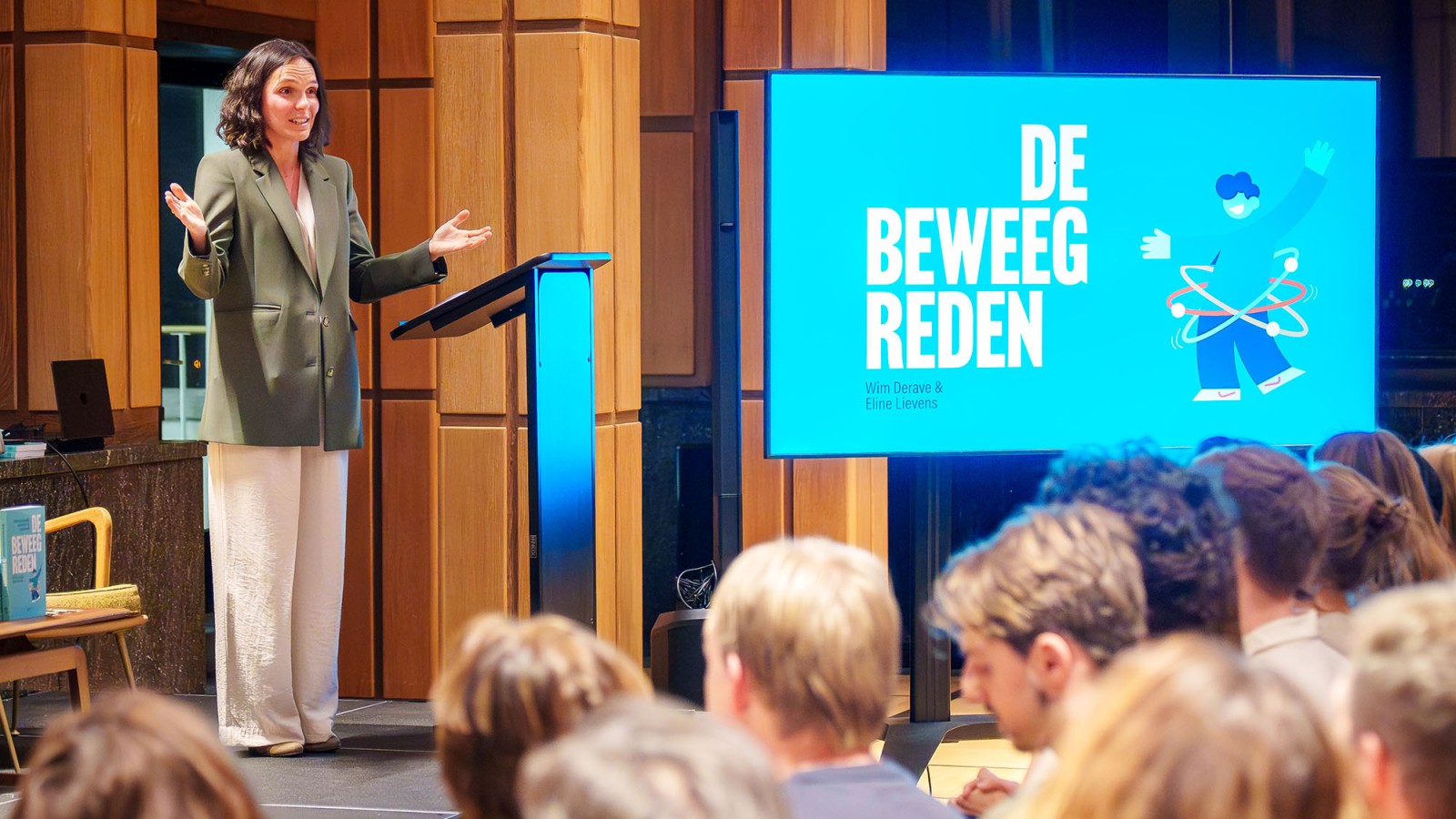
Eline Lievens: "Small changes may feel less impressive at first, but over time they make a huge difference. Your body needs time to adapt to new stimuli. Give it that time.”
Why we give up (and how to prevent it)
Every beginning is hard. “If you start running with a beginner programme, it feels tough and tiring at first. But once you get past that initial phase, it becomes more enjoyable. Over time, running can even start to feel as easy as walking. That may sound impossible at first, but your body can do far more than you think if you build up gradually.”
Building up gradually requires some patience. “Your first strength training session? Expect muscle soreness. Not for one day, but maybe three,” says Eline. “That’s normal. It's a sign your body is getting stronger, not a reason to stop. After a few sessions, it will feel less painful.”
We often start too ambitious. “People set high goals like running a marathon in three months starting from zero,” says Eline. It can be motivating in the beginning, but often ends in overload.
Overly ambitious plans aren’t sustainable: “An hour of sports every day is hard to maintain. Small changes may feel less impressive at first, but over time they make a huge difference. Your body needs time to adapt to new stimuli. Give it that time.”
‘Bucket-list athletes’ or ‘weekend warriors’ who only train intensely at weekends also have a higher risk of injury. “Challenge yourself, but in small doses. Look at your level at the moment and just add a little extra.”
Another pitfall is the bathroom scale. “Many people start to move in order to lose weight, but that’s not an easy strategy. Nutrition usually plays a bigger role in your weight, and the combination of exercise and diet works best. Even if your weight doesn’t seem to change, your body composition often does: more muscle, less fat. And even without weight loss, moving more can bring major health benefits.”
Five realistic ways to move more in 2026
- Choose something you genuinely enjoy, otherwise your effort won’t last. Did you use to love football and are you missing the competition? Try a variation like walking football.
- Keep the effort small (and therefore realistic). Are you at an average of 5.000 steps a day? Aim for 6.000 or 7.000. Small progress is more sustainable than an ambitious plan you'll quit after three weeks.
- Schedule it. Plan a lunchtime walk on workdays. Invite your colleagues too. It makes it less likely you’ll end up working through lunch instead.
- Make it visible. Put your running shoes by the door. Keep your workout clothes in your work bag. These tiny cues reduce the barrier to getting started.
- Use ‘exercise snacks’. No time for a full workout? Break up your exercise into short moments: take the stairs at a brisk pace, or do three minutes of fast walking between meetings. Get your heart rate up briefly a few times a day.
Want to know more?
Read De Beweegreden or listen to the audio book, both in Dutch. With the audio book, you can combine inspiration with action.

Eline Lievens is Professor of Exercise Physiology in the Department of Movement and Sports Sciences at Ghent University. She studies how muscles and movement influence our health, an is passionate about healthy lifestyles, with a focus on movement and nutrition.
The audio book De Beweegreden was created with the support from Ghent University’s social valorisation fund.
Read also
Researchers uncover new mechanism behind hereditary excessive sweating
Overmatig zweten lijkt een banaal kwaaltje, maar dat is het allerminst. Voor miljoenen mensen wereldwijd heeft hyperhidrose een grote impact op hun levenskwaliteit. Nieuw onderzoek werpt een compleet nieuw licht op de aandoening.

100 kilometres for Grandma: how student Kaat is supporting the fight against Parkinson’s
Ghent University veterinary medicine student Kaat De Haeck (26) walked 100 kilometres to support the Parkinson’s Research Fund. By taking part in the Dodentocht, a 100-kilometre walking challenge, she raised €2,000.

Does AI make our brains smarter or lazier?
We asked neurologist Kristl Vonck how she views the impact of AI on our brains. What happens to our brain when we systematically outsource thinking to an algorithm?

Bashir Abdi receives honorary doctorate: “This shows how powerful sport is"
For his unique combination of athletic excellence and social commitment, including his work supporting vulnerable young people in Ghent, Abdi is being awarded an honorary doctorate from Ghent University. “You don’t need an Olympic achievement to help others.”
