Borders are everywhere. In its new exhibition BORDERS, the Ghent University Museum (GUM) & Botanical Garden dissects the concept in all its forms: from biological membranes to bureaucratic walls and mental scars. By matching objects from its rich academic collections with contemporary art, the exhibition reveals borders not as fixed facts, but as ongoing negotiations experienced differently by each of us.
- BORDERS explores how borders shape our lives and how porous those lines really are: from the boundaries of our bodies to the “walls” between countries.
- You will discover a unique mix of objects, ranging from papier-mâché anatomical models and fragments of the Berlin Wall to contemporary art installations.
- BORDERS runs until 11 April 2027 at GUM & Botanical Garden in Ghent.
BORDERS marks a striking new chapter in the story of GUM & Botanical Garden. Since opening in 2020, the museum has positioned itself as a forum at the intersection of science and art. While previous exhibitions such as PHALLUS and TRUTH explored the limits of knowledge, this new exhibition turns its attention to the structures that define, challenge and sometimes divide our world.
The exhibition emerged from extensive preliminary research involving more than one hundred scientists from different disciplines. Their academic insights were interwoven with artistic interpretations. In De Grenswachters by Robbert & Frank, this becomes almost literal: two monumental figures filled with weaving looms reaching out toward one another. Visitors entering through the Botanical Garden walk directly beneath them. It is one of several works specially created for the exhibition by five Ghent-based artists. Their creations can be found throughout the Botanical Garden, the greenhouses, the city centre and, above all, the museum itself.

Strange objects
As soon as you enter the exhibition,you are confronted with a life-sized X-ray image of a torso. In the middle of the windpipe sits a sharply outlined metallic object shaped like a dog — an unsettling image that instinctively triggers the swallowing reflex. “That provocation is deliberate,” says Professor Marjan Doom, director and curator of GUM. “You immediately relate it to yourself. It’s both comical and disturbing: that playful puppy clearly does not belong there.”
The uncomfortable image introduces the first of the exhibition’s four themes: Vreemd(eling). This section invites visitors to reflect on where the self begins and ends. That boundary turns out to be far more porous than we often assume. Marjan explains: “If I inhale air, does it become my air? Or take the microbiome, the billions of microorganisms living on and inside our bodies. Are they part of ourselves? Biologically speaking, they are ‘strangers’, yet without them we simply could not exist.”
Right at the boundary between self and other stands the guardian between a pregnant body and a foetus: the placenta. Various specimens and anatomical models demonstrate how each mammal species prevents the body from rejecting the foetus as foreign tissue. Standing beside one of the models, Marjan points out: “In this cow placenta, you can see all these tiny suction-like structures. This is where the blood vessels of mother and foetus intertwine. It is a delicate border between life-sustaining exchange and rejection.” Remarkably, the model by physician Louis Auzoux is made entirely from papier-mâché and glue. “That technique democratised scientific education: inexpensive, fast to produce and highly detailed.”
Barriers of paper and disease
We move on to the second storyline: Oversteek. Here, the border becomes movement, an action that may feel effortless for some and impossible for others. “You only truly experience a border when you collide with it,” says Marjan while discussing the research of Ghent University legal anthropologist Ellen Desmet. Her work on migration and entry documents demonstrates how fluid borders can be. “Ellen studies how factors such as gender, origin and educational background determine how thick the paper wall becomes. The wall you have to negotiate your way through. Here, the border is not a physical fence, but a stack of documents that creates and reinforces inequality.”
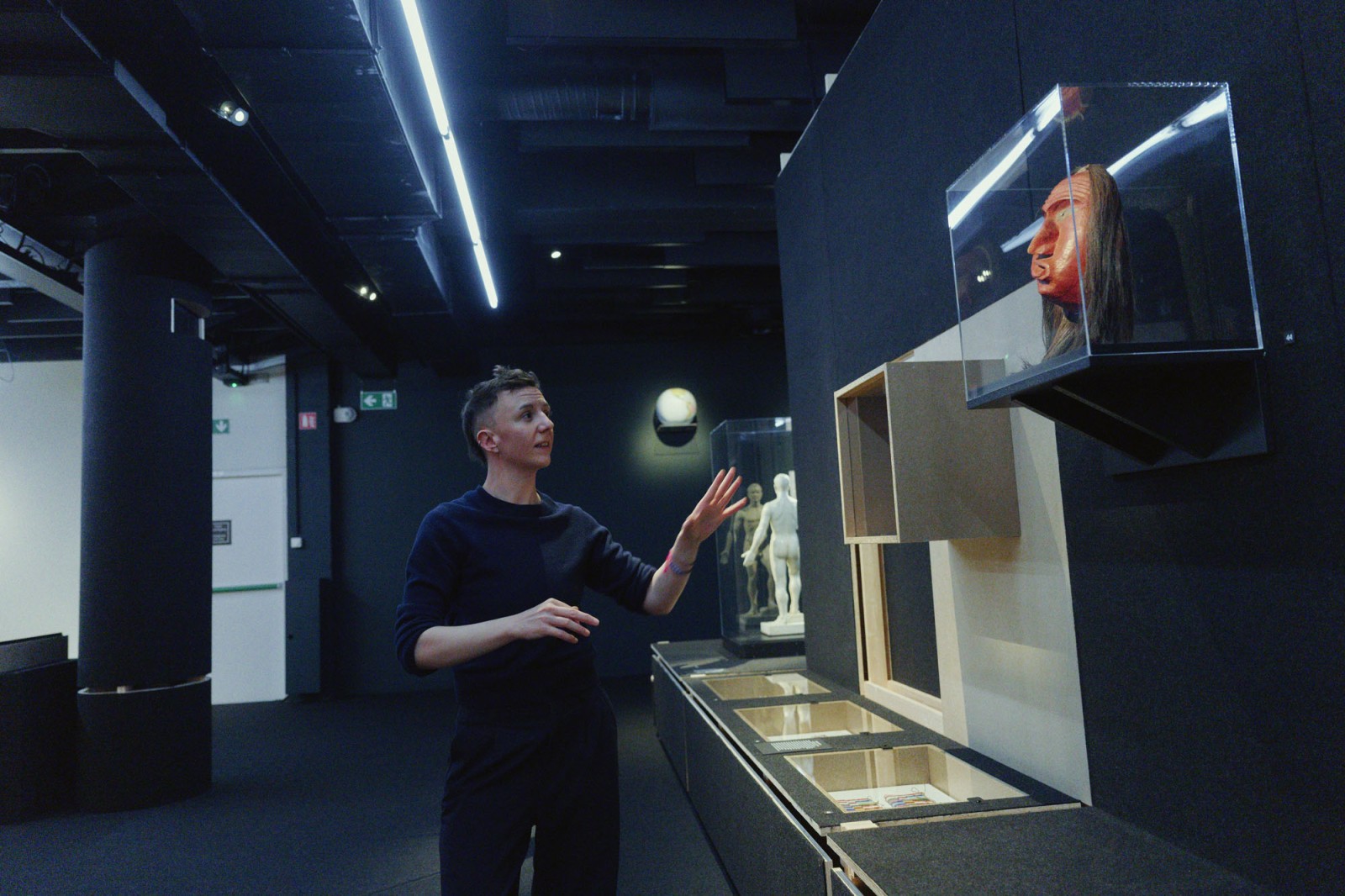
These crossings concern not only people, but also what they carry with them. “The first encounters between European colonists and the Iroquois (part of the Haudenosaunee Confederacy) in North America brought not only trade and culture, but also cholera and other deadly diseases.” The False Face Society, the Haudenosaunee medicine society, used masks to combat these “white contact diseases”. Not blue surgical masks, but vivid red faces twisted in pain and covering the entire head. “Ironically, such masks became popular among colonial collectors precisely because of their sacred significance,” Marjan explains. “In 1995, the Haudenosaunee prohibited the public display of authentic masks. They did, however, create replicas for the Western market, like the ones displayed here today.”
Walls and water
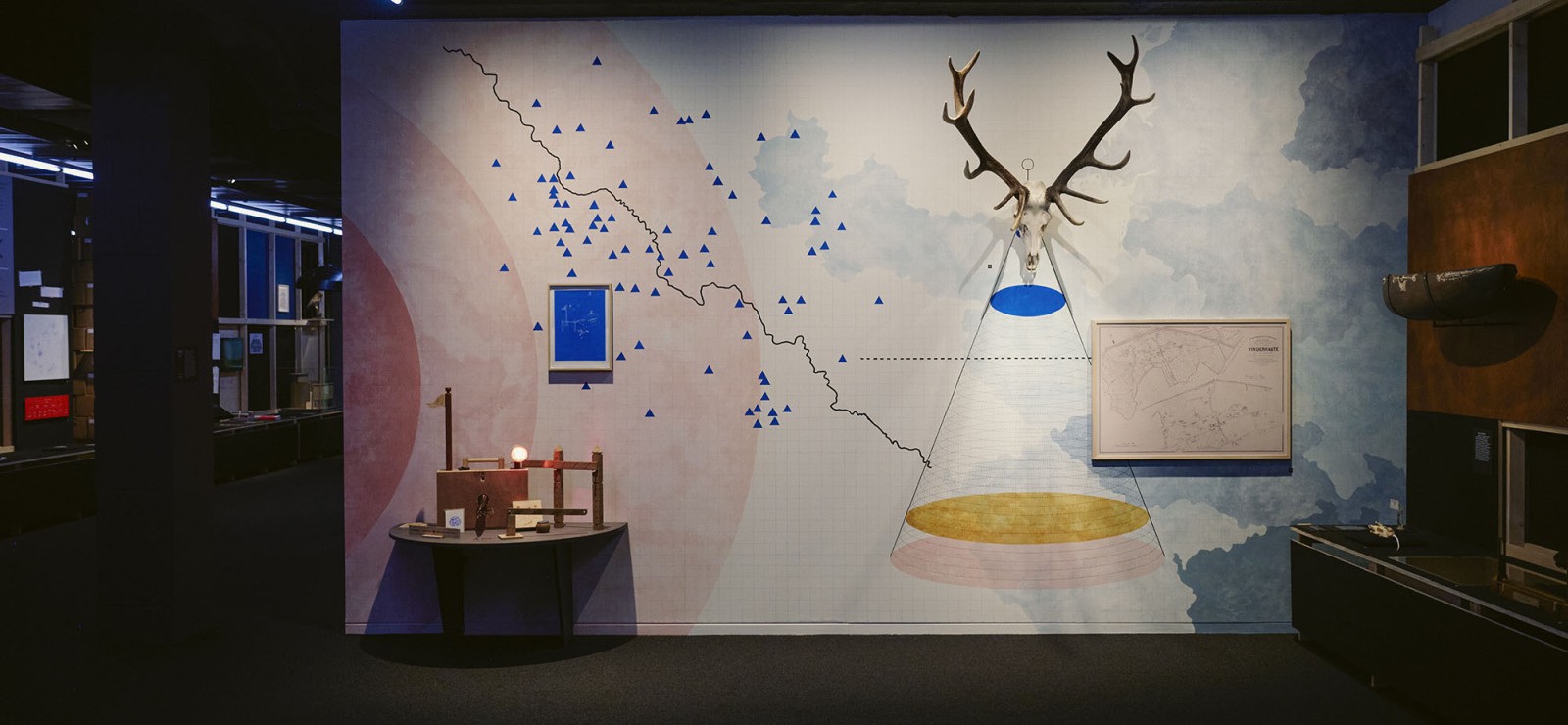
Organising, demarcating, dividing: many borders were once drawn by people. In the third theme, Eiland, authentic fragments of the Berlin Wall and the Iron Curtain demonstrate how brutally rigid borders can become — yet also how rarely they last forever. Marjan points to the phenomenon of Mauerkrankheit. “People living on the East German side of the Wall demonstrably suffered more frequently from depression and anxiety disorders. The border did not exist only in concrete; it crept into people’s minds.” Even nature does not entirely escape its effects. “Research shows that deer populations still follow the invisible line of the former Iron Curtain today. The collective memory of the border appears stronger than its physical absence.”
Alongside these harsh objects stands something of fragile beauty: a stick chart from the Marshall Islands. “In the West, we tend to see islands as isolated points in an empty ocean. The sea separates us. Marshallese navigators reverse that perspective: for them, the sea connects," Marjan says with a smile. Shells and knots indicate islands, while the sticks represent waves and currents. “It shows that the definition of a border depends entirely on how we look at the world. Instead of islands in a sea, they see a sea of islands.”
Between life and death
In the final stretch of the exhibition, visitors enter Niemandsland, perhaps the most mysterious section of the exhibition. Theatre scenographer Roel Van Berckelaer designed the space with subtle intelligence. Gone are the sharp lines of the previous sections. Instead, the floor gently curves with rounded corners. “The corridor seems to float, like a kind of waiting room: belonging neither fully to one side nor the other.” At its centre hang two objects marking the greatest border of all: a Mayan death mask, one of the highlights of the collection, and an African hyena mask. “That mask was used in a Malian rite of passage,” Marjan explains. “Young men around the age of twenty had to symbolically die in ‘the world of women’ and, after a temporary stay in no man’s land, be reborn on the other side as men.”

A little further on stands a striking installation: a tower-high stack of boxes. “Bieke Depoorter created The Right to be Forgotten? especially for this exhibition and developed it in dialogue with us,” says Marjan. The Ghent-based artist spent years photographing the same person and previously published a book about their intimate yet complex relationship. “But today, the person portrayed no longer wants the work to be shown and invokes the European ‘right to be forgotten’. With these boxes, filled with all unsold copies of the book, Depoorter explores how to deal with this new boundary.” Or how an absent artwork can itself become the artwork.
BORDERS invites visitors to question their own boundaries and thresholds. The exhibition runs until 11 April 2027 at GUM & Botanical Garden. Discover the current BORDERS programme here.
Read also
Bashir Abdi receives honorary doctorate: “This shows how powerful sport is"
For his unique combination of athletic excellence and social commitment, including his work supporting vulnerable young people in Ghent, Abdi is being awarded an honorary doctorate from Ghent University. “You don’t need an Olympic achievement to help others.”

Three new Stolpersteine in Ghent: the tragic story of Rifca, Valère and Falks
Around thirty Stolpersteine can be found in the sidewalks across Ghent. On November 5th, three more were added for Ghent University victims Valère, Falks, and Rifca.

Judith or not? In search of the first Countess of Flanders
TV show Het verhaal van Vlaanderen was certain: the box just unearthed from the City of Ghent's heritage depot contained the remains of the one and only Judith, the progenitor of the Counts of Flanders. But was that really true?

From research to impact: how technology transfer works at Ghent University
Ghent University not only attracts researchers and students, businesses also like to establish a presence near the university. Excellent research, know-how and highly trained professionals constitute the ideal breeding ground for innovation.
