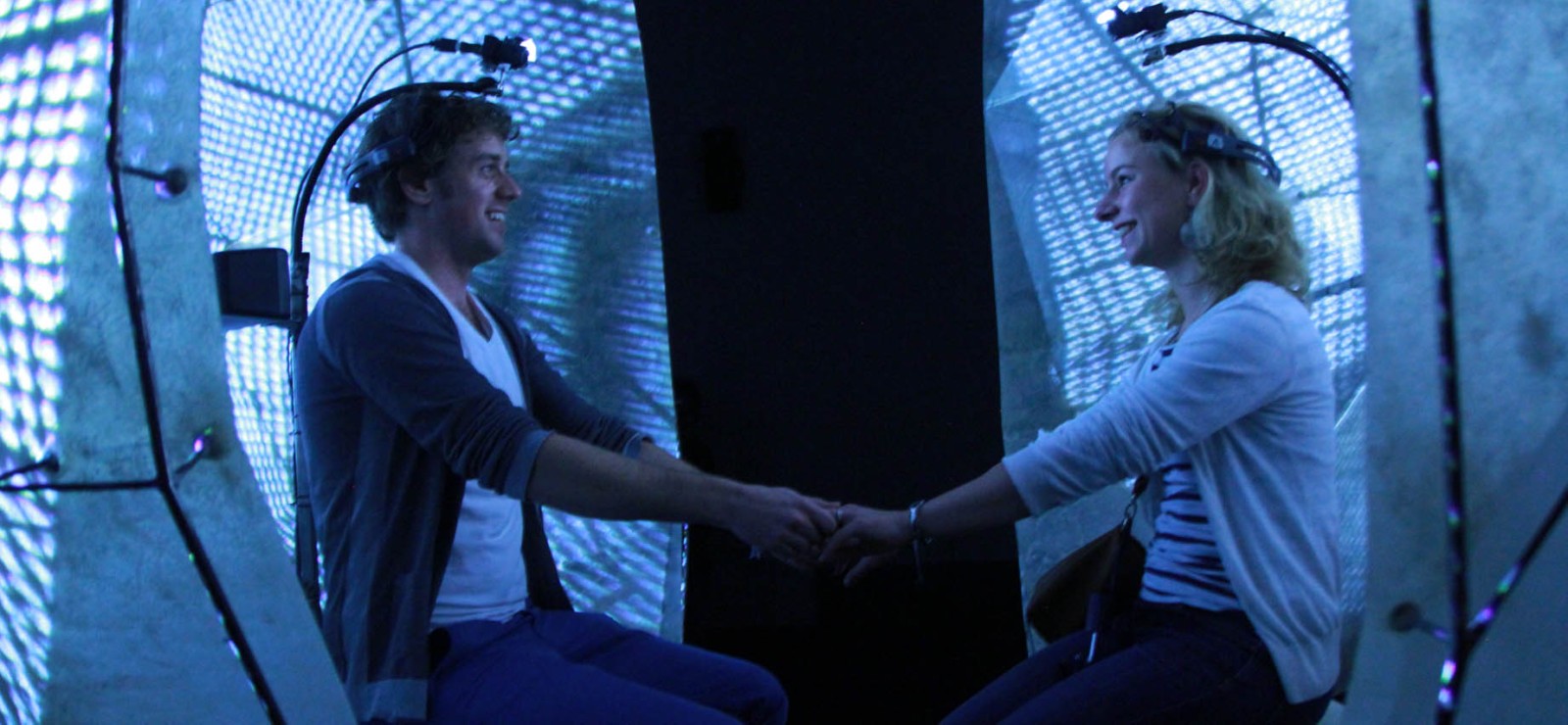
Everyone knows the feeling: a conversation that flows so naturally words almost seem unnecessary, a classroom where ideas spark effortlessly, or a concert where thousands of people move as one. But is there scientific evidence that people can literally be "on the same wavelength"?
In short
- Suzanne Dikker studies brain rhythms during social interaction.
- Her research shows that being "on the same wavelength" is more than just a feeling—it’s a measurable brain process.
- The process may be strengthened, opening up potential applications for well-being, learning and therapy.
- The findings were published in Trends in Cognitive Sciences, one of the most prestigious journals in cognitive science.
Scientists refer to this phenomenon as social synchrony: the alignment of brain rhythms, body language and speech patterns between people during social interaction. But can this sense of connection actually be measured?
An international research team led by Suzanne Dikker, professor at Ghent University and affiliated with New York University, has found a nuanced yet encouraging answer: yes.
From festivals to museums: research in the real world
Suzanne and her team deliberately took their research beyond the laboratory. Over the course of ten years, they used portable EEG headsets to record the brain activity of thousands of participants in museums, at festivals and in schools.
The researchers also collaborated with Latin American musicians Bad Bunny and Residente, recording their brain activity while they created music together. The EEG data clearly revealed synchronised brain activity during their performance.
"Our years of experiments show that we can consistently measure the seemingly elusive concept of being 'on the same wavelength'," Suzanne says.
Positive effects in the classroom
The research among secondary school students revealed a striking pattern. The more synchronised the students' brain activity was, the more positively they evaluated both one another and the lesson itself. Students whose brain activity became synchronised during class also remembered the learning material better.
"Social synchrony plays an important role in healthy social relationships and in learning," Suzanne explains. "There is growing evidence that face-to-face activities promoting interpersonal synchrony are essential for maintaining social cohesion within communities."
The next step: deliberately enhancing synchrony
Can we actively encourage the process of getting "on the same wavelength"? That is the question Suzanne and her colleagues are now exploring. By gaining a better understanding of how social synchrony emerges, they hope to develop insights that contribute to stronger social connections, better learning environments and new therapeutic applications.
Their research suggests that connectedness is not only something we experience—it is also reflected in the rhythms of our brains, our behaviour and our communication. According to the researchers, this may hold an important key to understanding how people learn, collaborate and build relationships.
The science behind the photo
For her research, Suzanne Dikker used The Mutual Wave Machine, an installation at the intersection of art and science. Two participants sit opposite each other while EEG sensors record their brain activity. The surrounding light patterns visualise their brain synchrony in real time.
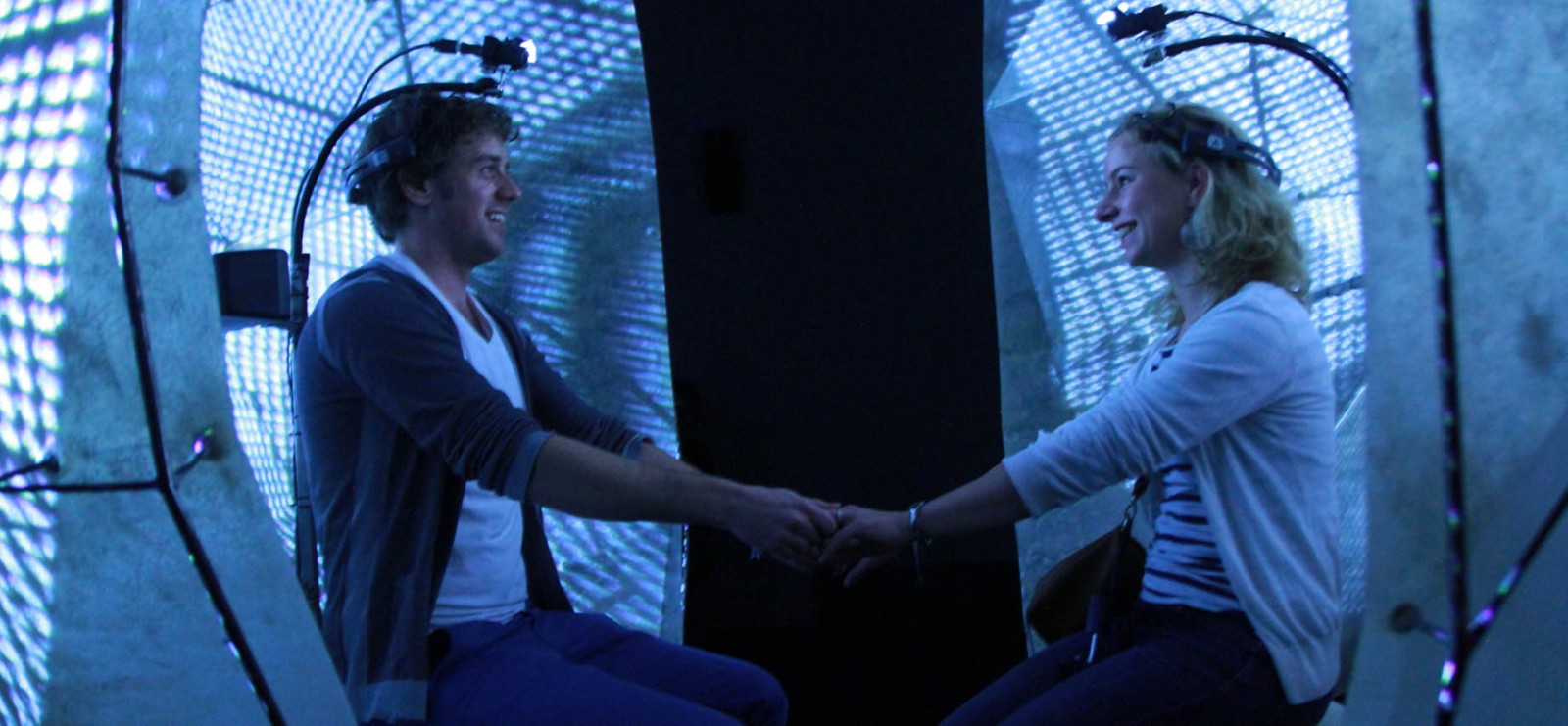
Want to experience what it feels like to be "on the same wavelength"? At De Empathiefabriek (The Empathy Factory) in the University Museum Utrecht, Suzanne invites visitors to experiment with brain waves themselves.

Suzanne Dikker has been a professor at the Faculty of Psychology and Educational Sciences at Ghent University since 2025. Her interdisciplinary research is part of the InterCom project, funded by a European Research Council (ERC) Consolidator Grant. The findings were published in Trends in Cognitive Sciences, one of the leading journals in cognitive science.
Photo header: Sandra Kaas
Photo biography: Thaddeus Rombauer
Read also
Chat line for and by students even known to the king
Students Oshin and Jarne founded Epione, a chat line for and by students, two years ago. Meanwhile, their initiative to improve students' mental well-being is even on the radar of the Belgian King.

Do you fall in love more quickly in the summer?
“Summer lovin', had me a blast. Summer lovin', happened so fast.” Danny and Sandy felt it already in the classic film Grease: during the summer there is love in the air. But is there any truth in it? Do we fall in love more quickly in the summer?

Laura Sels seeks the secret to a successful relationship
For Laura Sels, not a day goes past without talking about relationships. You could call her a romantic, although she doesn’t necessarily believe in the ‘one and only’. She spends a little too much time looking at things from a research perspective for that: after all, as a postdoc, she is studying emotional processes in romantic relationships. “I can spend hours philosophising and thinking about them. I am also keen to actually help couples in the future.”

Forget Tinder, head for the Boekentoren
The place to be if you are looking for scientific literature, periodicals, theses or manuscripts…. And who knows, maybe even the love of your life? For some, the magnificent setting of the Ghent University Boekentoren tower has not only been a place to study, but also the beginning of something beautiful.
