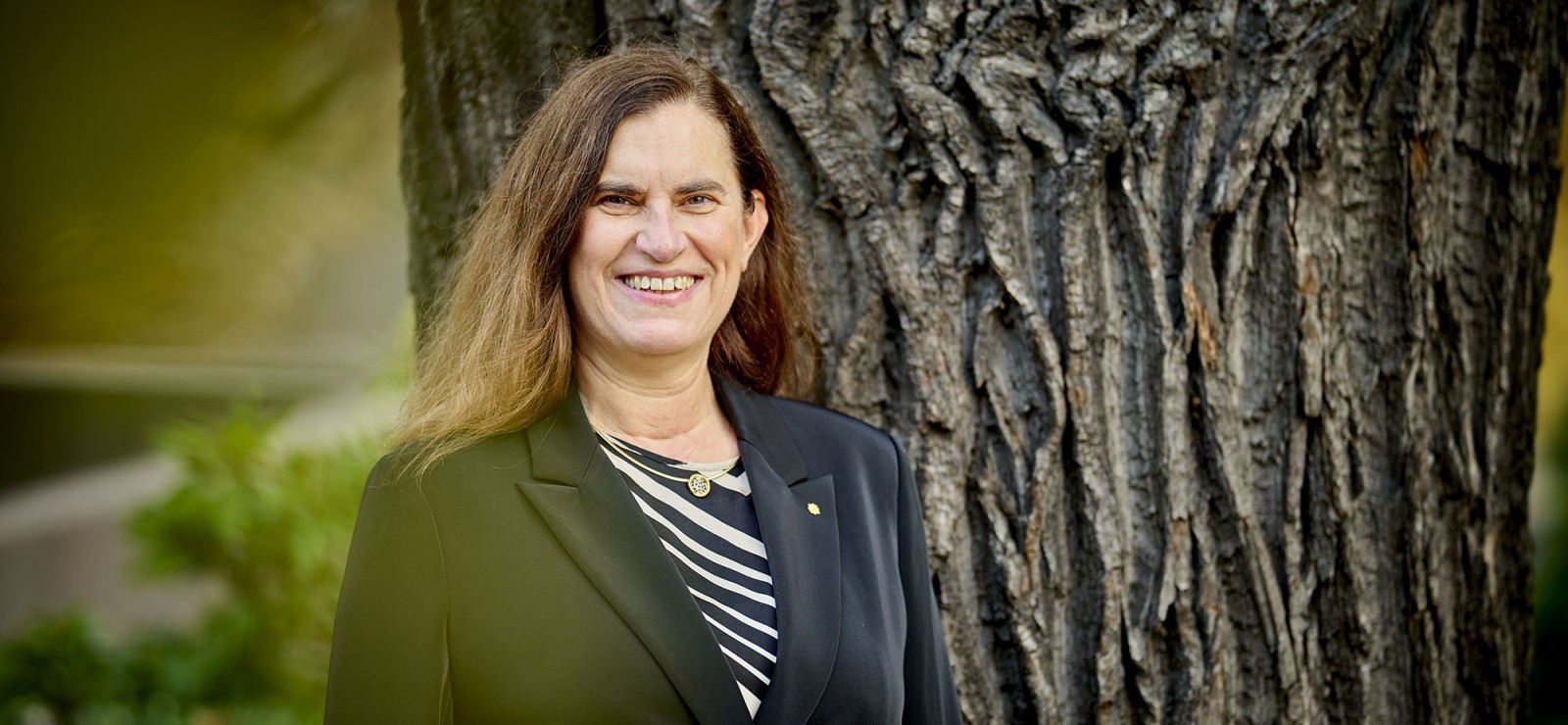
Ellen Moons studied Physics at Ghent University in the 1980s and built an international career through her research into solar cells. Since 2026, she has been Secretary-General of the Royal Swedish Academy of Sciences, the first woman since 1739. In this role, she announces the laureates of three Nobel Prizes. Yet she remains remarkably down-to-earth about her journey. "I never had a big plan. I simply followed my curiosity."
Ellen Moons in short
- Studied Physics at Ghent University from 1984 to 1989
- International researcher in solar cell technology, with a focus on organic solar cells
- Since 2026 Secretary-General of the Royal Swedish Academy of Sciences, the first woman in the role since 1739
- In that position, she announces the Nobel Prizes for physics and chemistry, as well as the Prize in Economic Sciences in memory of Alfred Nobel
- Combines her mandate at the Academy with a professorship in physics at Karlstad University in Sweden, where she has lived and worked for 25 years
The jury and nominators praise Ellen Moons for her impressive international academic career, her exemplary role for women in science and engineering and for her strong commitment to science communication, through which she connects impact with societal relevance. They describe her as agile, internationally minded and inspiring. Anyone who meets her also notices something else: Ellen Moons is thoughtful. During the interview, she carefully weighs her words. And those words carry a Swedish tone here and there, hardly surprising after 25 years in the Scandinavian country.
Ellen Moons started her journey as a student at Ghent University but has been living and working in Sweden for years now. Today she is a Professor of Physics at Karlstad University and in 2025 she served on the Swedish National Fund for Sciences. She was a member of the committee that awards the Nobel Prize in Physics for some time and now she is Secretary-General of the entire Royal Swedish Academy of Sciences. For example, over the next four years, she will personally inform the laureates of various Nobel Prizes. But not before she herself is first honoured as Ghent University Alumnus of the year 2026.
Congratulations on this award. What was your first reaction?
"I received an email from the rector. A complete surprise. I was surprised and happy, it really came out of the blue. It was also very moving to read those nominations and see how many people had nominated me, and why."
In 1984 you started as a physics student at Ghent University. What comes in mind when you think back to that?
"Cycling. (laughs) We cycled everywhere: from the Sterre Campus to the Jozef Plateaustraat and back. There were very few physics students, so we took many courses together with students from other programmes. It was a very nice group with whom I still have occasional contact today."
"I also remember how overwhelming those first weeks were. You pick up that thick pile of course books and think: how am I ever going to get through this? I even quit for half a day. It didn’t look feasible. With the support of home, I returned. I studied hard in the first few years, the typical student life was not for me."
Who at Ghent University influenced your direction?
"Too many to mention! Professor Walter Gomes in physical chemistry, for example, encouraged me to go abroad. I did my thesis with Professor Felix Cardon, in the Department of Solid State Sciences. That's where my passion for solar cells developed. And then there are those smaller memories: a professor who wrote something on the board and at the same time was erasing something else (laughs). You had to stay focused."
Where did your fascination with physics begin?
"With my physics teacher in the atheneum of Veurne. He made the lessons exciting with experiments in the classroom. We started from observations and derived formulas from them. Without realizing it at the time, that was the essence of scientific research: testing hypotheses. The seed to become a researcher was planted there. When I received the Swedish Prize for Physics in 2011, my former teacher contacted me. He wanted to write about it in the school newspaper."

“I do see my role as an icebreaker for future generations. I think it is extremely important that women have their opportunity to work in science.“
You wanted to go abroad early on, in a time without Erasmus. Why this wish?
"Curiosity. And also the desire to work on solar cells. During my thesis year, I was particularly interested in indium tin oxide, a transparent conductive layer in solar cells. That topic was at the bottom of the list of thesis topics, and I was ultimately not allowed to choose it. But the interest remained and I wanted to go abroad for that."
"Through a small brochure about bilateral scholarships that I discovered by chance, I ended up going to Israel with the help of Professor Cardon. Nine months as a visiting student turned into five years of PhD research. That was not easy. I really had doubts. But again: step by step. And I adapt easily. Each new country gradually became a home. After Israel I didn't return to Belgium, but you can't take the West Flemish clay out of me. I miss ham rolls with chicory (laughs)."
In the meantime, you have been doing research abroad for more than 35 years. What does your research focus on today?
“"On organic solar cells. Traditional silicon cells are efficient but require a lot of energy to produce and are not flexible or transparent. Organic solar cells can potentially be cheap, lightweight and flexible. You could print them on a roll. But the lifespan is still too short. Nobody wants to replace their solar panels every year. We investigate why they degrade. Curiosity and the pursuit of social impact remain my main motivations in this fundamental research."
You have been Secretary General of the Royal Swedish Academy of Sciences since 2026. Were you hesitant to say 'yes'?
"Yes. Because I didn't want to completely let go of my research and my PhD students. But such an opportunity may not come a second time. We now have an 80/20 split in mind: eighty percent Academy, twenty percent University. And the Academy plays an important role in science and science communication. That really appealed to me."
What does your Nobel role involve in concrete terms?
"In recent years, I have already worked on the Nobel committee for the physics prize. But now that I have this position, I have stepped down from that committee. The selection and preparation are done by the committees. In my new role, I call the laureates on the day of the announcement and do the announcement and press conference. The committees then provide the scientific explanation."
What does it mean to you that you are the first woman in that position since 1739?
"I was also explicitly told that when I was asked the question (laughs). Of course that is historic, but you don't make such a decision for that reason. I do see my role as an icebreaker for future generations. Visibility matters. When young women see examples, confidence grows that doors will not remain closed. I think it is extremely important that women have their opportunity to work in science. It was a great pleasure to read the motivations of the female researchers who nominated me as Alumnus of the Year. They put me forward as a role model, even though that is not my goal."
As a woman, can you bring a different perspective to the Nobel Prize process?
"It doesn't work that way: Alfred Nobel's will still determines the criteria. You qualify for a Nobel Prize in physics only as the inventor or discoverer of something that is of great use to humanity."
"Because there is a lot of time between fundamental research and final applications, the Nobel Prize often goes to older laureates. Predominantly men, because in the past there were far fewer women doing research. So, I do expect that more and more female researchers will win a Nobel Prize in the future."
"The Academy does actively work on equal opportunities in its structures. And I try to encourage and nominate young female researchers for opportunities and prizes in my own environment. Because unfortunately, they still face barriers and prejudices today. Even in Sweden, praised for its equal opportunities policy, only 30 percent of professors are women."
What would you say to your 18-year-old self?
"Follow your interest. And break big steps into small ones. When you look at the whole picture, it sometimes seems overwhelming. But break it down into smaller steps and it becomes achievable. And that gives courage for the next step. The fact that I can announce the Nobel Prizes today was not something I ever expected. But it's great. I'm really looking forward to it."
Read also
Ghent University Alumnus of the Year: who were the previous laureates?
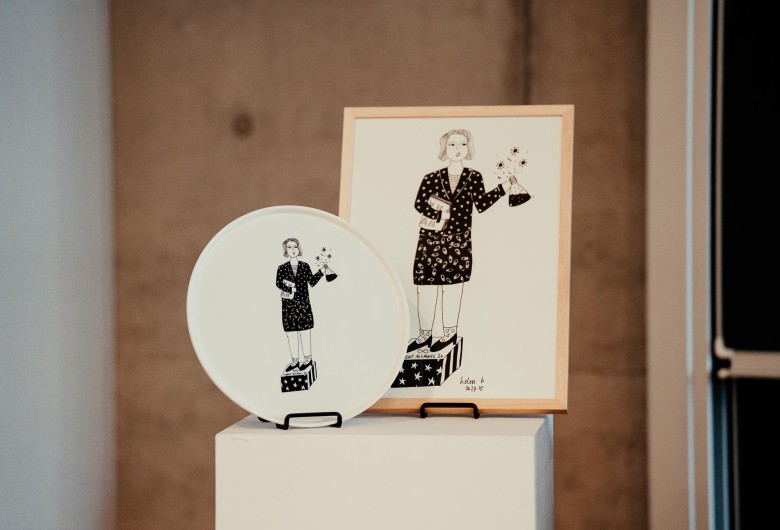
The Ghent University Alumnus of the Year award is still a recent tradition at Ghent University, but one that is here to stay. Because Ghent University wouldn't be Ghent University without our alumni, we honour one former student who has made special achievements each year. So which alumni received the award in the past?
photos: Patrik Lundin, ©The Royal Swedish Academy of Sciences
Read also
Back to university with Sarah Vandeursen: "It took me a while to find my place within the university system"
These days, you may know Sarah Vandeursen as a television and documentary maker, artist, lover of Flemish dry-cured sausages, or perhaps still as Conny Komen of the band Kenji Minogue. What is less well known is that her story at Ghent University began in Political and Social Sciences. Eventually, she found her way to social work.

Gentrepreneurs on the buzz of entrepreneurship: “If I can help students, I’ll consider the year a success”
Thinking of starting a business as a student? Emilia De Graeve and Hannes Van Cauwenberghe would recommend it to anyone. Emilia, a psychology master’s student and co-founder of Blokmap, and Hannes, an alumnus of Ghent University and founder of several companies, take a moment to reflect on their lives as Gentrepreneurs. “Ghent University only makes your ideas more outlandish.”

Back to university with Karolien Olaerts: “I was a real model student”
You may know her from her cookbooks, blog, or Instagram channel Karola’s Kitchen. But before her career as an author and food blogger, Karolien Olaerts studied biomedical sciences at Ghent University. On campus Rommelaere, she looks back on her student days.

Back to university with Davina Simons: "I have many fond memories of my student days"
As the first in her family to go to university, Davina Simons (30) had to make it happen largely on her own. In 2019, she earned her master's degree in law from Ghent University. In no time, she became one of the Belgium's best-known criminal defense lawyers and today she runs her own law firm.
