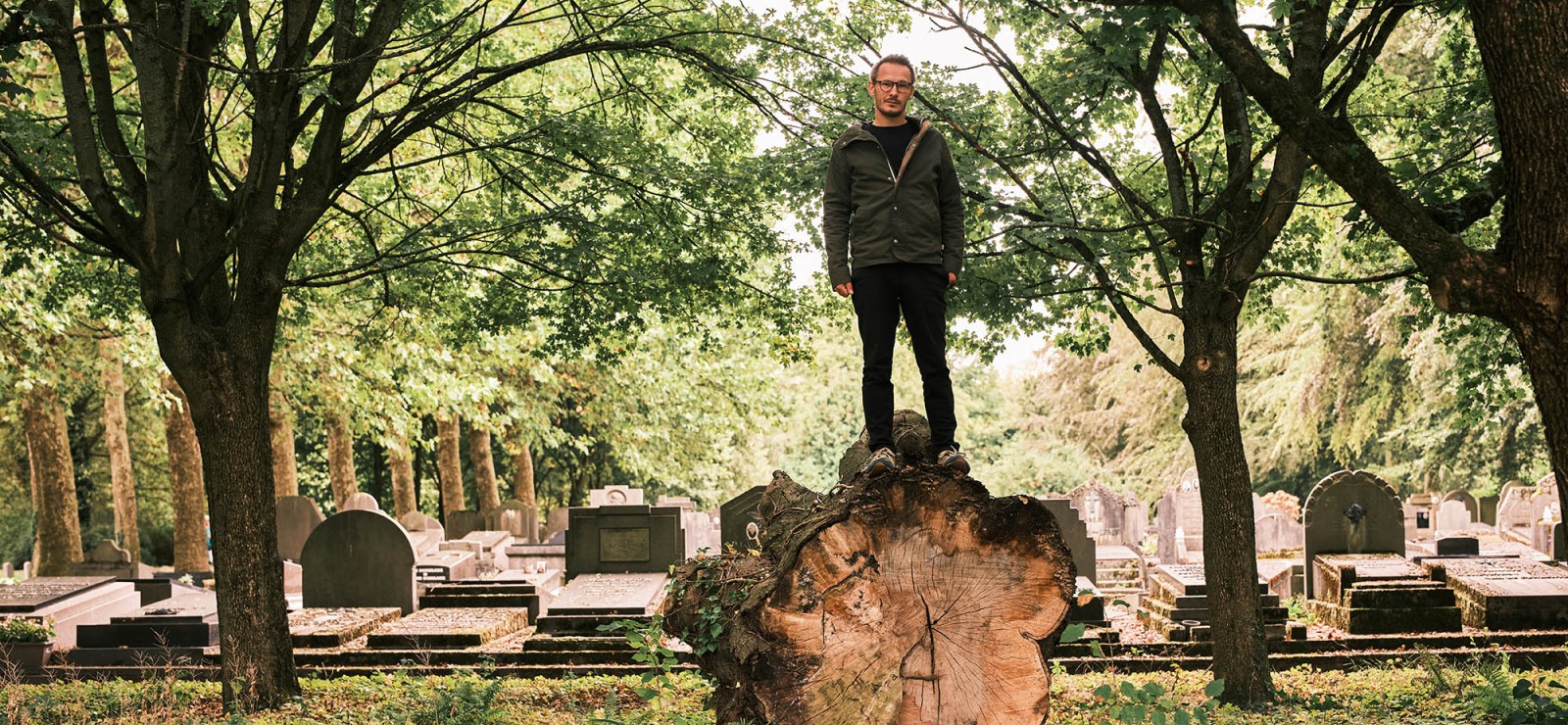
In 2014, Pieter Deknudt organised the first edition of Reveil at the cemetery of his hometown Deerlijk: an intimate tribute to his late friend Robbie, lit by candlelight and accompanied by the sound of a guitar. What began as a personal farewell has since grown into a movement working towards a warmer, more open culture around grief and remembrance. Through memorial concerts in cemeteries and other initiatives that give stories of loss a place, Reveil now reaches thousands of people every year. Today, it is active across more than 150 cemeteries in six countries.
Born from the loss of a friend
Even during as a student, Pieter enjoyed bringing people together. As cultural officer for his student association, he organised initiatives such as a multilingual day for fellow students. “Connecting people, encouraging people to step outside their comfort zone and bringing them together: that has been the common thread running throughout all my projects, from my band Zinger to Reveil.” That desire to connect people took on a deeper meaning when he lost his friend Robbie.
“Reveil grew out of my grief after losing my friend Robbie. We were both part of the same music scene in Deerlijk. He loved heavy guitars and thought the trumpets in my band Zinger were absolutely terrible. In April 2012, he was killed in a car accident on his 24th birthday. I was 27 at the time. In the six months that followed, three more young people from the same student group also passed away. It felt almost unreal.”
What affected Pieter most was not only the loss itself, but the silence that followed. “The anniversary of Robbie’s death came and went, and nobody marked the occasion. The same happened on All Saints' Day. That really stayed with me. Why were we just letting these moments pass without acknowledging them?”
A song at the graveside
That question sparked an idea that was initially met with scepticism. “A year after Robbie’s death, I wrote the song Grace and wanted to play it at his grave. My friends thought it was disrespectful. To me, it felt like the most respectful thing I could do for him.”
So, at sunset on 1 November, he went ahead with it. Accompanied by his band Zinger and the light of a handful of candles, he performed the song at the cemetery. “I was afraid people would react negatively, but the cemetery was packed.”
That single performance turned out not to be an ending, but a beginning. “When our band won De Nieuwe Lichting, Studio Brussel’s talent competition, our story began to spread. What started with around ten performances has, ten years later, grown into a network of more than 150 cemeteries across six countries. Last year, 15,000 candles were lit along the coast in Nieuwpoort, and our televised closing event reached 200,000 viewers.”

"Grief is not a journey with a finish line. It is a language you have to learn."
Grief is a language you have to learn
Over the years, Pieter immersed himself in the science and history of grief. Combined with his own experiences and countless conversations, this research became the foundation of his book Grief Can Be Different. In it, he takes both a critical and hopeful look at the way Flemish society approaches loss.
“As healthcare became increasingly professionalised, grief gradually became more taboo making death feel distant and clinical. Yet humans have used culture, ritual and beauty to navigate major life transitions for tens of thousands of years. When we started Reveil, Halloween was rapidly gaining popularity in Flanders, partly because we lacked our own traditions for finding comfort and remembering the dead. To me, it felt right to transform that cultural vacuum into a colourful, homegrown culture of remembrance and comfort.”
According to Pieter, society also needs to move beyond the outdated idea that grief follows a neat sequence of stages and eventually comes to an end. “Grief is not a journey with a finish line. It is a language you have to learn. The notion that grief ends with ‘acceptance’ has long been challenged by researchers, yet it remains deeply rooted in the public imagination. I’m a big fan of the dual process model, which compares grief to rowing a boat with two oars: one focused on the loss itself, the other on rebuilding your life. If you only use one, you keep going in circles.”
Flanders is a pioneer in compassion, without realising it
What began in a cemetery in Deerlijk has since gained international attention. In the process, Pieter says, he has come to see Flanders differently. “Flanders is a global pioneer in new approaches to grief and remembrance, but very few people realise it. It was only when I attended a conference in Los Angeles that I understood how far ahead we actually are. Ideas that researchers there are still evisioning have been a reality here for years. Organisations such as Boven de Wolken, which offers professional photography to families of stillborn babies, or Postkantoor 00/00/00, where people can write letters to those they have lost, are just a few examples. In total, more than forty pioneering non-profit organisations are helping shape this landscape.”
At the same time, he believes grief still does not receive the attention it deserves. “Bereavement support remains far too low on the political agenda. Organisations doing essential work often rely on volunteers and limited resources. Governments and businesses should invest much more in initiatives that help people through difficult times. The expertise already exists; the support simply needs to catch up.”
""Culture is not a luxury. It is one of the foundations of society. It saves lives and creates meaning and connection."
Towards a renewed culture of remembrance
For Pieter, the conclusion is clear. “Culture is not a luxury. It is one of the foundations of society. It creates meaning and brings people together, especially at a time when traditional forms of community are playing a smaller role among younger generations.”
With Reveil, he hopes to continue building that culture. “Alongside our remembrance concerts on 1 November, we now develop programmes centred on consolidation and remembrance together with cities and municipalities. This year, Tielt is our ‘Capital of Consolation’. Through our new project, Radio Reveil, we are also working with care homes, cafés and youth centres to create a Flemish canon of songs that bring comfort. Perhaps one day we can even make Ghent a Capital of Consolation. Mayor De Clercq is welcome to call me anytime.”
Pieter has come a long way from the young musician who struggled to find a place for his grief. “When I think of Robbie now, I smile. I chose to face my grief instead of pushing it away. Over time, it became something like a melancholic friend who drops by every now and then.”
Finally, he has a message for his alma mater: “Last summer at Rock Werchter, my musical hero David Byrne said: ‘Love is the new punk.’ If punk once meant rebelling against the establishment and breaking things, then today it means caring for one another and embracing vulnerability in an increasingly harsh world. I hope Ghent University helps its students cultivate that kind of gentle rebellion, perhaps through internships with non-profits or other forms of engagement. Because meaning is not a luxury. It saves lives.”
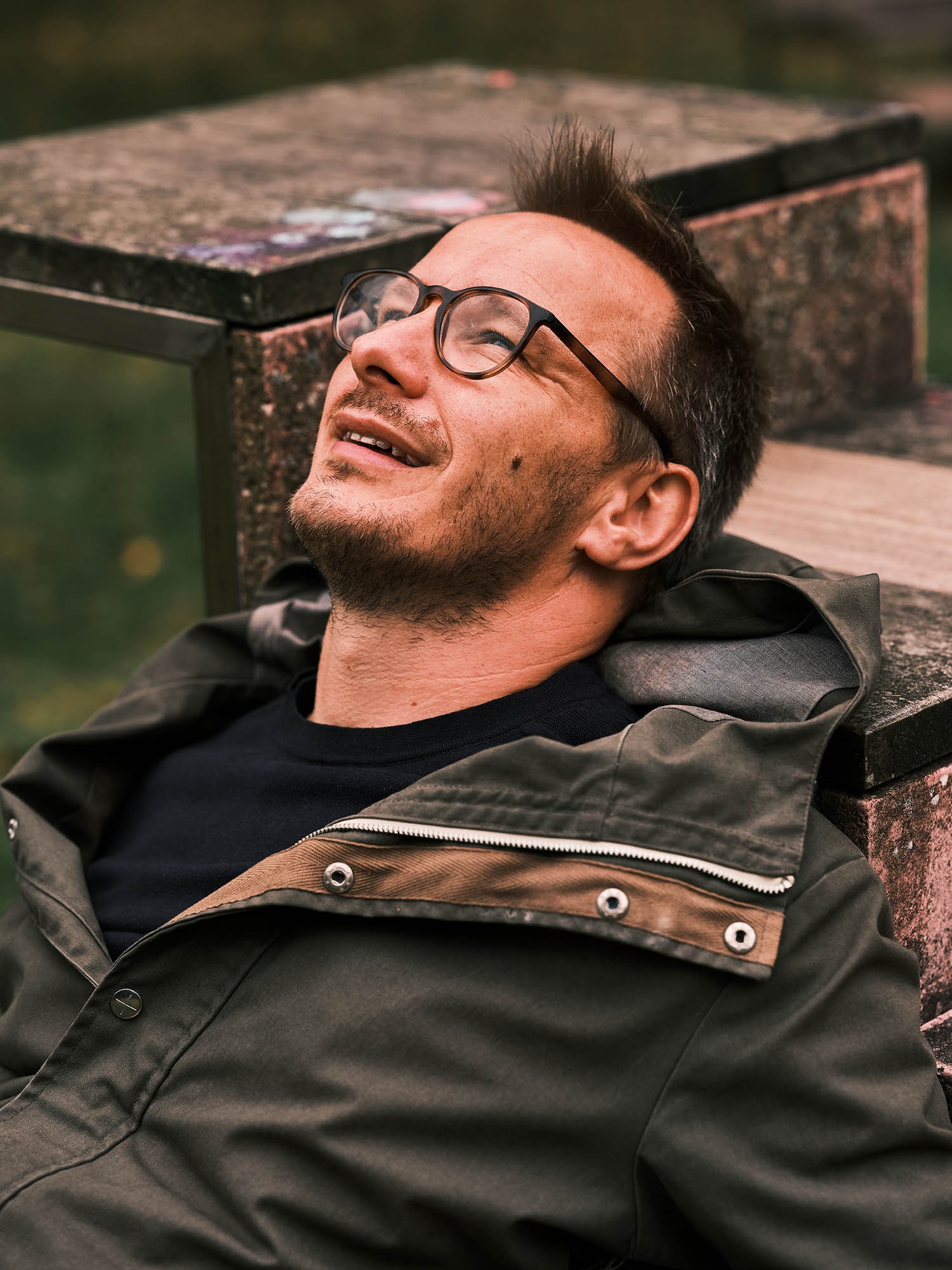
Pieter Deknudt graduated in 2008 with a master’s degree in Translation and Interpreting (French, English and Dutch) from what was then known as Hogeschool Gent. The programme is now part of Ghent University’s Department of Applied Language Studies. He worked as a teacher for fifteen years before devoting himself full-time to Reveil. He is also the lead singer of indie-pop brass band Zinger and the author of Grief Can Be Different.
Read also
The eternal dilemma: which queue is it best to join?
Imagine that bar service is allowed again and you can choose between two different drinks counters at a festival. One has orderly lines marked with posts, the other is entirely at random. Which option should you choose in order to get your drink fastest?

On the overlap between the academic and cultural worlds
Ghent University rector Rik Van de Walle still remembers so well just how impressed he was by La Reprise, the last theatre performance by Milo Rau before his official appointment as artistic director of NTGent in September 2018. "From that very moment I was certain that we should give Milo a honorary doctorate some day. Everyone I spoke to on the subject was keen on the idea, so things progressed far quicker than I had imagined."*

Art as a ray of hope in Syria
The 2011 revolution did not bring about freedom for Syrians. The civil war in the country has already claimed hundreds of thousands of victims. Gradually, despair has set in. “But if you look closely, there are some rays of hope. We need to highlight those in order to not further dehumanize the people who are trapped in the conflict,” says Middle East expert Brigitte Herremans.
