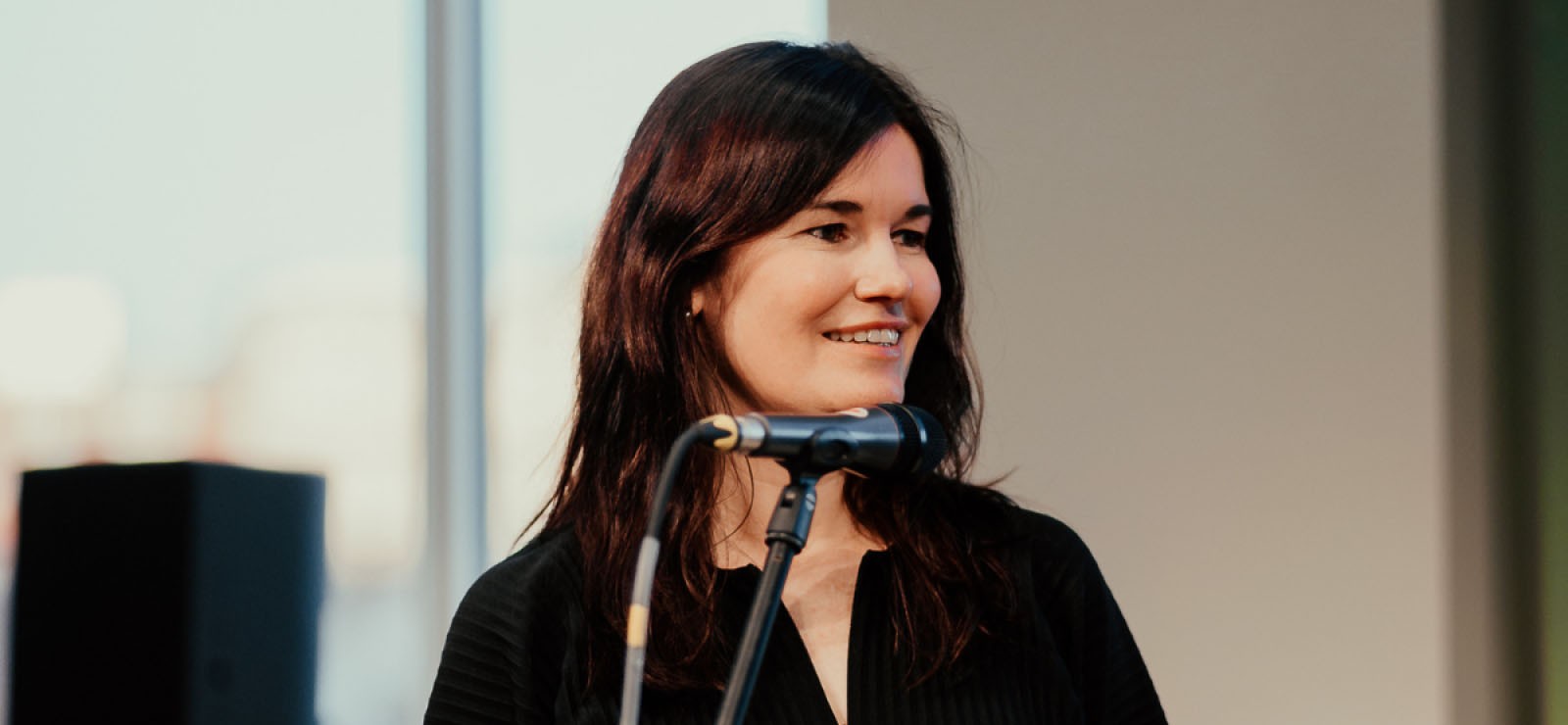
We asked linguist Orphée De Clercq about her perspective on the influence of AI on how we speak and write. Will we soon lose our sense of language? Orphée De Clercq wrote this opinion piece in connection with the event ARTIFICIËLE INTELLUGENTIE on 4 March 2026.
The driving force behind today’s generative chatbots is language, more specifically large language models. They are computer systems trained on enormous amounts of data, on enormous amounts of language. Language has thus become a technological product, one that currently occupies a very prominent place in the field of AI. Paradoxically, at the same time society’s attention to and appreciation for language seem to be declining. Academic programmes centred on language are being questioned, and even basic language skills are under pressure. After all, why would you still learn a (foreign) language yourself, read something thoroughly, or struggle your way through writing a text when you can simply outsource those tasks to a chatbot that is always available? The result is “good enough”.
But language is not merely a task. It is not a problem that needs to be solved or outsourced. Language is a means, the means that we as humans have chosen to tell our stories, connect with one another and, through writing among other things, try to capture and share knowledge. The fact that linguistic data led to the breakthrough in AI shows that we have succeeded in that last ambition to some extent. Language seems to be the key to true artificial intelligence and, if we believe the narrative of Big Tech, that kind of intelligence and even superintelligence may be just around the corner.
Today I would like to focus on two aspects that show why a purely solution-oriented focus on language may not be what we should strive for. First, language models are only as good as the data on which they are trained. Second, language is about much more than words.
In the field of machine learning we speak of GIGO: garbage in, garbage out. Automated systems will only produce valuable output if the input they receive is high-quality and relevant. Quality should therefore prevail over quantity. That is precisely where the problem lies, because scale has dominated in recent years. The current generation of language models has been trained on almost every human text ever written. We do not know exactly which texts and which languages were used because that information is not disclosed. What we do know is that a large part of the training data consists of a massive dump of the global web. The internet certainly contains a treasure trove of information, but at times it can also resemble a sewer.
We also know that the web largely consists of English-language data, roughly one third of the total. At the same time, of the estimated 7,000 languages spoken worldwide, only a few hundred are represented online. The best-known and most popular models such as GPT, Llama, Gemini and Claude are therefore multilingual only up to a certain point. They also clearly favour English, a form of language bias. One possible solution would be retraining the models, but the problem is that very little authentic text remains available. As a result, researchers increasingly rely on synthetic data or hybrid forms. This is not without risk because it may quickly create a self-reinforcing loop of garbage in, garbage out.
This language bias also filters into the output and gradually finds its way into our Dutch language. That influence is not new. English has been shaping our language for quite some time. But beyond the growing number of anglicisms, shorter words and sentences and the well-known em dash, we also sense something else in the many texts now written with generative AI. At the university, for example, we notice it in the many bachelor’s and master’s theses we read. Suddenly it seems that far more groundbreaking research is being conducted, at least if we judge by the grand rhetoric that appears in these texts. That rhetoric strongly resembles the style often associated with American culture.
This brings me to my second point. Language is about much more than words. Language is also about thinking, and both our thinking and our language are shaped by the history and culture in which we grow up and live. We know that languages evolve over time and through contact with other languages and cultures. We also know that communication can sometimes be a delicate process. Anyone who has ever felt “lost in translation” while travelling knows that communicating across languages requires more than simply translating words. You must be able to adopt the perspective of the target culture.
Here too language models fall somewhat short. They may be multilingual, but that does not make them multicultural. The predominance of English training data translates into a largely Anglocentric worldview. When you communicate with people from other cultures, even when using English as a lingua franca, you will sooner or later be corrected if you misstep culturally. Chatbots do not do this. On the contrary, through language models we may unconsciously be nudged toward a particular worldview, gradually drifting toward uniformity. Uniformity in our texts, uniformity in our language and perhaps even uniformity in our thinking. And in the process, do we not risk losing part of our identity and authenticity?
This brings me back to the start. Language is a means and cannot simply be reduced to tasks or problems that need to be solved. The whole is greater than the sum of its parts. We must move away from purely solution-driven thinking and once again place humans and human language at the centre. Today the focus is too much on AI taking over everything. It is essential that humans remain in control and, so to speak, keep their hands on the controls.
Putting humans at the centre is also the guiding principle of the humanities. I therefore believe that in the future we will need more strong humanities profiles and more strong thinkers. It may sound as if I am placing the humanities and STEM disciplines in opposition to one another, but that is not the case. Both remain essential. What we must do better is learn to speak the same language and build bridges between them. For me, there is no better place than the university to help build that bridge. I am therefore proud that at Ghent University we take on such a pioneering role, through public lectures, through our research and through the programmes we offer to the strong thinkers of tomorrow.
In short
- Generative AI relies on language and transforms language into a task that can be solved.
- Language models are only as good as the data they're trained on. There's a risk of impoverishment, uniformity, and a bias toward English.
- Language is about culture and thought. Therefore, according to Orphée De Clercq, humans and not AI should remain central to knowledge and education.
Orphée De Clercq is professor of Language Technology for Educational Applications at the Faculty of Arts and Philosophy (Department of Translation, Interpreting and Communication). Her research falls within the field of language technology (Natural Language Processing or NLP), and she uses machine learning techniques to investigate how language technology applications can be used for computer-assisted language learning.
Read also
AI is taking work off our hands, but is it also taking the joy out of work?
AI can write text, generate code and summarise mountains of information in seconds. Useful, certainly. But what happens when technology starts taking over the very parts of our jobs that give us a sense of accomplishment?

Does AI make our brains smarter or lazier?
We asked neurologist Kristl Vonck how she views the impact of AI on our brains. What happens to our brain when we systematically outsource thinking to an algorithm?

Will robots soon leave us without work?
We asked economist Amy Van Looy how she views the use of robots in the workplace. Are our jobs at risk?

Evil genius: what René Descartes can tell us about AI
We asked philosopher Ignaas Devisch to share his thoughts on how we should deal with AI. He revisits Descartes’ thought experiment.
