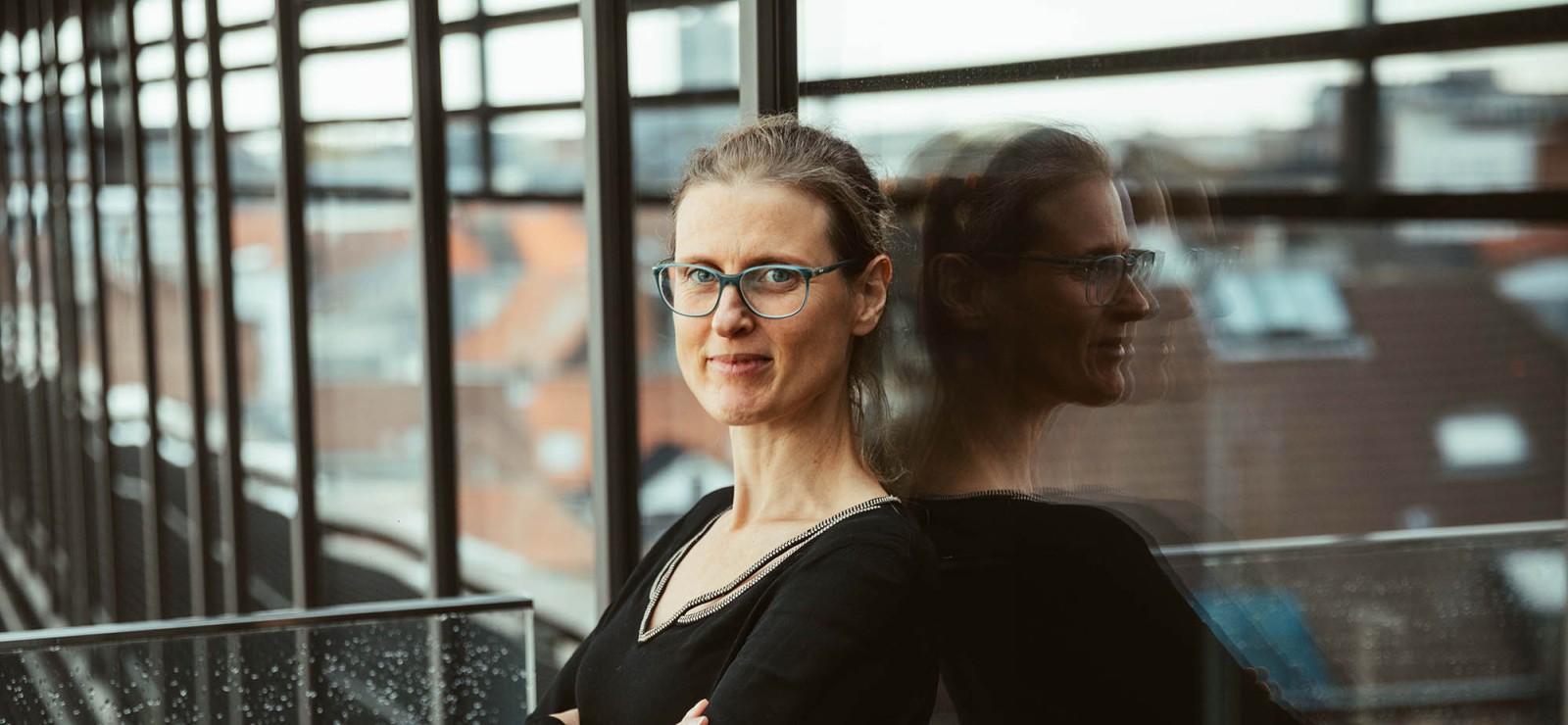
AI can write text, generate code and summarise mountains of information in seconds. Useful, certainly. But what happens when technology starts taking over the very parts of our jobs that give us a sense of accomplishment? Communication scientist Mariek Vanden Abeele explores a less visible side of the AI revolution: its impact on job satisfaction, self-confidence and how we perceive our own expertise.
In short
- Research suggests that using AI as a practical work tool can affect our wellbeing.
- The key question is not only which tasks AI can take over, but which tasks we actually want to hand over.
- According to researcher Mariek Vanden Abeele, the challenge is not to resist technology, but to use it consciously and thoughtfully.
Is AI good or bad for our wellbeing? If you're expecting a straightforward answer from Mariek Vanden Abeele, you'll likely be disappointed. Generative AI is still too new for that. “At this point, the research only covers the past three to four years,” she says. “We simply don't have enough long-term evidence yet. We're still in the process of understanding this technology ourselves.”
That doesn't mean we know nothing about its effects, however. “We do, however, have well-established theoretical insights into wellbeing and what constitutes good work. Those insights allow us to make some informed assumptions about how AI may influence our wellbeing at work.”
According to Vanden Abeele, that means looking beyond the most eye-catching stories about AI. Not just at chatbots posing as therapists or friends, but at something much more ordinary: the AI tools many of us increasingly use to work faster and more efficiently.
“Even this highly functional use of AI affects our wellbeing. In fact, its impact may even be much greater than we currently realise.”
From creating to evaluating
Writing a text, coding or solving a complex problem: AI can now take over more and more steps in these processes. While that can save time, Vanden Abeele believes it also changes our relationship with work. “In the past, a sense of accomplishment often came from learning to master a process. Think about learning to write well. You develop skills, practise, receive feedback and gradually improve. Now, the focus risks shifting towards the final output rather than the learning journey itself.”
As a result, our role is changing. Instead of creating something from start to finish, we increasingly receive a result that we must assess, verify and refine. That may sound like a subtle difference, but much of the satisfaction people derive from work lies precisely in the act of creating. “Work gives us many things. A sense of achievement is one of them. Decades of research show that personal growth through work is essential to our wellbeing.”
Could employees become discouraged when AI starts taking over tasks that rely on skills they spent years developing? After all, our expertise often forms part of our identity. “Skills are deeply intertwined with who we are,” says Vanden Abeele. “The constant pressure to keep upskilling can feel overwhelming. It can create anxiety. What do I need to learn next? And will what I'm learning today still be relevant tomorrow?”
"We have well-established theoretical insights into wellbeing and what constitutes good work."
The question, then, is not only which tasks AI can take over. It is also which tasks we want to remain our own.
Whatever happened to the boring moments?
Then there is another major promise often associated with AI: saving time. But working faster does not necessarily mean working less. “Ever since the start of industrialisation, we've seen that automation and higher productivity do not automatically lead to shorter working hours. That's a false promise,” says Vanden Abeele. She recalls her own early years as a researcher. As a PhD student, she sometimes spent forty minutes standing by a photocopier copying a book. “It was incredibly boring,” she laughs. “But it also gave you an opportunity to chat with colleagues. You had time to reflect and think about your work.”
As these tasks disappeared, so did many of the natural pauses built into our working day. AI may accelerate that trend even further. “We're increasingly removing those moments. The result is that we're asking our brains to operate at full capacity all day long. That's extremely demanding.” Only to find ourselves having to consciously slow down again after work. With a touch of irony, Vanden Abeele puts it this way: “You're running at full speed all day, and then at night you have to lie on a yoga mat during a mindfulness session to find the calm you no longer had the chance to build into your day.”
Pandora's box has been opened
Should we simply stop using AI? Vanden Abeele doesn't believe that's realistic. “Pandora's box has been opened. We'll have to learn how to navigate our relationship with it.” For her, the challenge is not about holding back technology. It is about consciously shaping the way we use it. As individuals, we can ask ourselves whether AI is supporting our work or replacing something we genuinely enjoy doing. But teams and employers also have a responsibility.
“We shouldn't see ourselves as victims. AI is a human-made technology. We created it. That means we also have agency: both individually and collectively, we can decide how to act.” What our working days will look like in ten or twenty years remains an open question. Which tasks will we delegate to AI? Which skills will we continue to develop ourselves? What will be the impact on our confidence and motivation? Will the time we save create more breathing room, or simply raise expectations that we should achieve even more?
“Sometimes we forget that society is something we all create together,” Vanden Abeele says. “It's a bit like traffic congestion: we often talk about the traffic jam as if it's something external, but we are the traffic jam. In the same way, a society in which AI is fully integrated is something we collectively shape.” Perhaps that is the most interesting question AI raises today. Not just what the technology can do for us, but which parts of our work we still want to do ourselves.
Read also
Does AI make our brains smarter or lazier?
We asked neurologist Kristl Vonck how she views the impact of AI on our brains. What happens to our brain when we systematically outsource thinking to an algorithm?

Will robots soon leave us without work?
We asked economist Amy Van Looy how she views the use of robots in the workplace. Are our jobs at risk?

Evil genius: what René Descartes can tell us about AI
We asked philosopher Ignaas Devisch to share his thoughts on how we should deal with AI. He revisits Descartes’ thought experiment.

Who decides what AI is allowed to say?
We asked AI professor Tijl De Bie how he views the limits we should or should not impose on AI.
