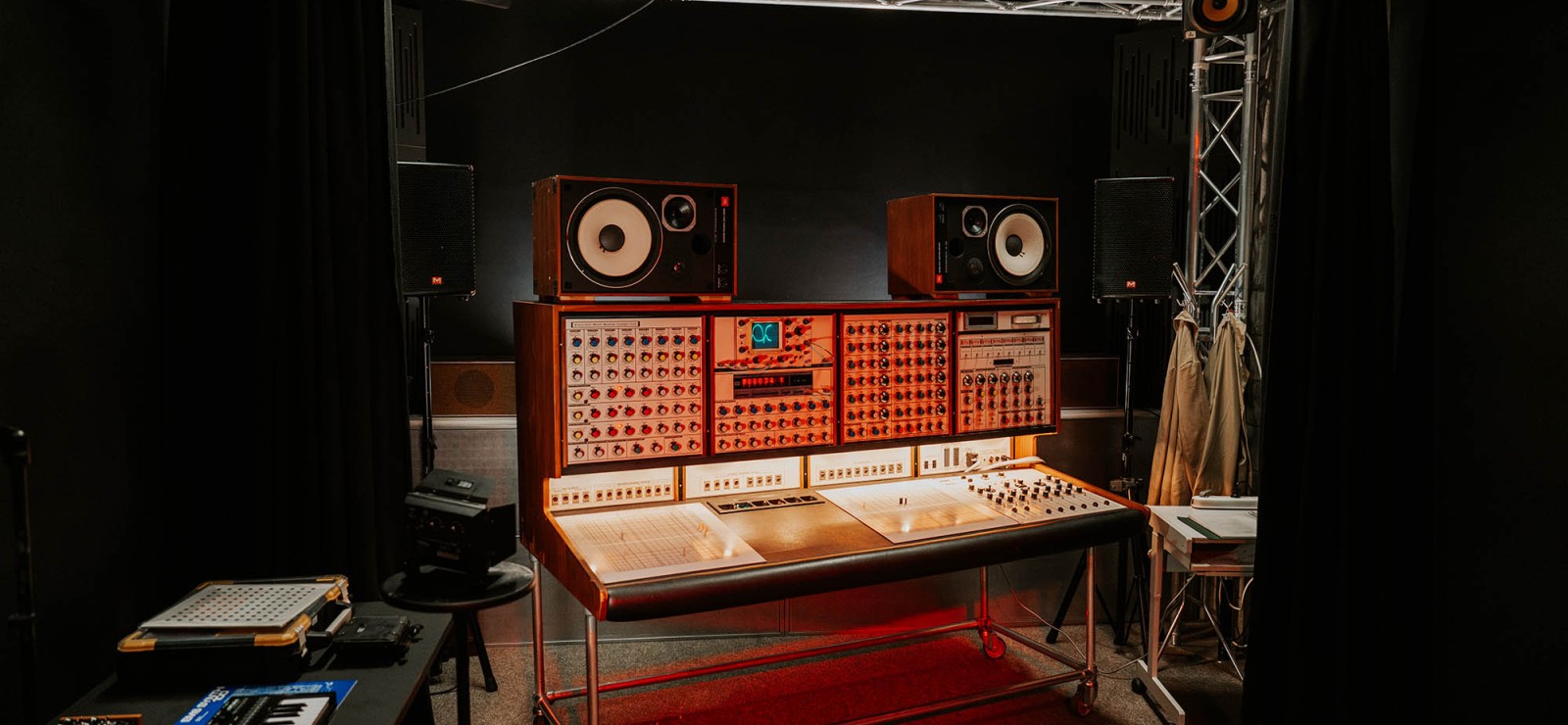
It is a piece of music history, yet chances are you have never heard of it: the EMS Synthi 100. Only a handful of working units remain worldwide, and one of them is housed in Ghent. But what makes this analogue synthesizer so legendary? And what do Ghent University and Soulwax have to do with it?
Hidden away in Ghent University’s laboratories beneath De Krook stands a machine the size of a wardrobe. It is covered with hundreds of knobs, a small screen displaying sound waves, and a massive patch matrix filled with tiny metal pins. It looks more like the control panel of a spaceship than a musical instrument.
A living ghost
The Synthi 100 was a game-changer in the electronic music industry. To understand why, we need to travel back to the 1970s, the pioneering days of electronic music, when technical problems were often part of the creative process.
“Because electronic sound generation was still such a new technology, studios relied on networks of separate power supplies and modules,” recalls retired audio technician Ivan Schepers, who spent his entire career maintaining the Synthi 100. “Electrical hums and noise would appear out of nowhere and disappear just as unpredictably. It was like a living ghost in the studio.”
Then came the Synthi 100. For the first time, a wide range of sound modules was brought together in a single integrated system with a central power supply, dramatically improving reliability.
The Synthi 100 at Ghent University is particularly special. It is the thirtieth and final Synthi 100 ever produced by Electronic Music Studios (EMS) in London, and rolled off the assembly line in 1979. It was purchased jointly by the Belgian public broadcaster BRT and the university for the Institute of Psychoacoustics and Electronic Music (IPEM). While the broadcaster was looking for new artistic possibilities, Ghent University recognised its potential as a fascinating subject for musicological research.
Connecting sounds with metal pins
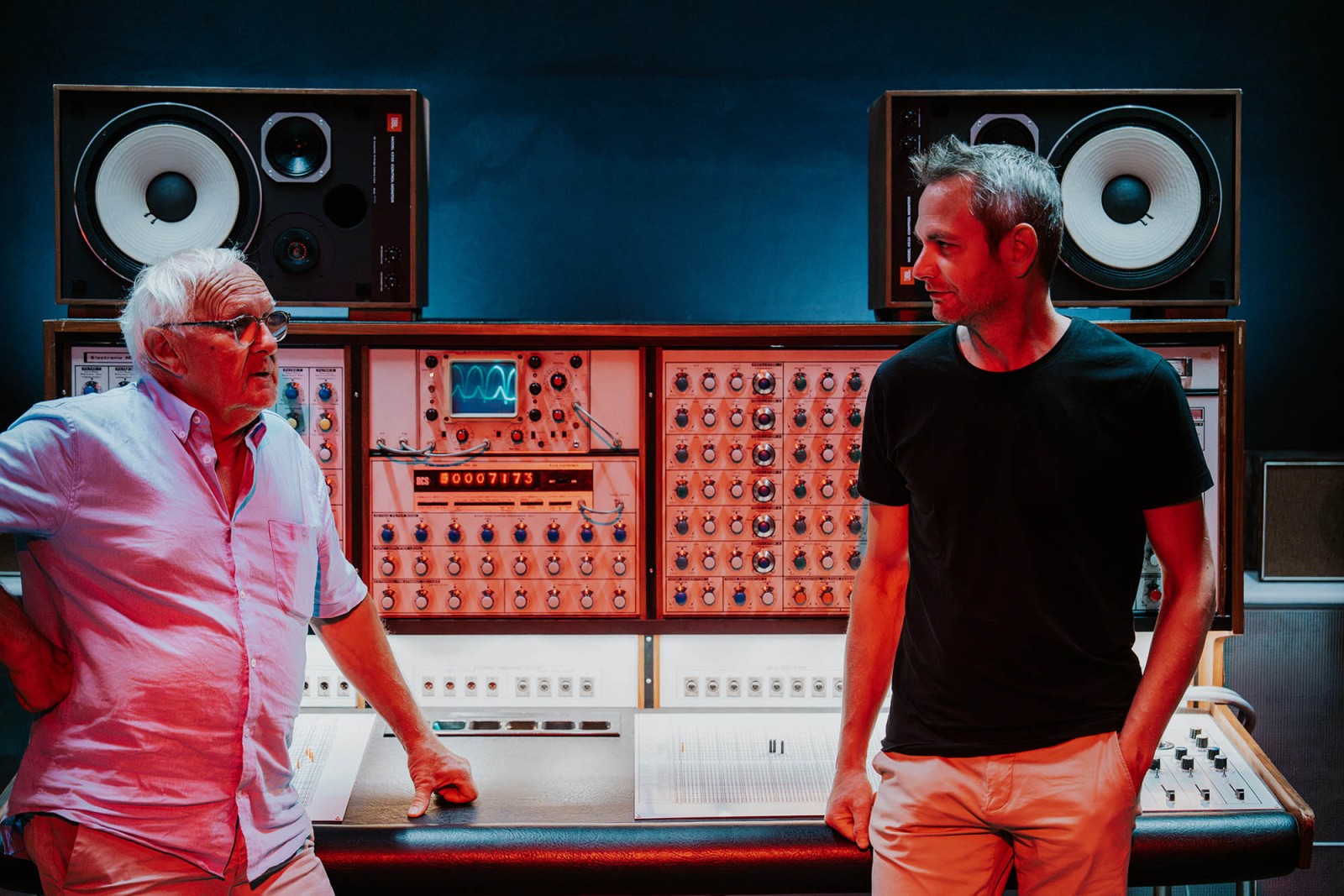
Do not expect to play the Synthi 100 like an ordinary keyboard. According to Bart Moens, coordinator of the eXtended Reality and Human Interaction Labs (XRHIL) and curator of the Synthi 100, experimentation is at the heart of the instrument.
“It was not designed to play music in the traditional sense,” he explains. “It was designed to experiment, explore and discover new sounds.”
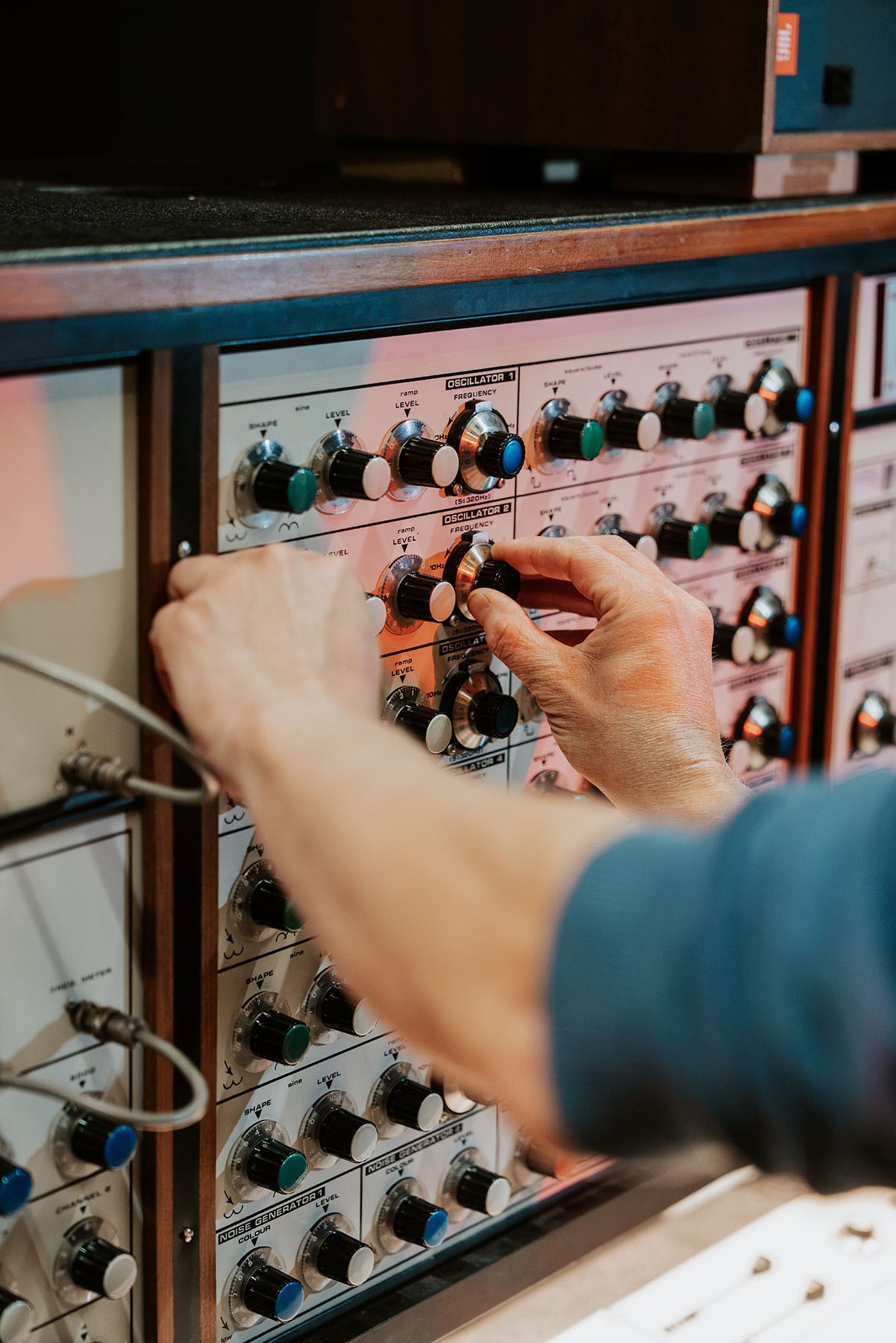
Everything starts with what is known as patching. By inserting metal pins into the large matrix, users physically connect different sound modules. The resulting signals can then be shaped using the machine’s many knobs, adjusting characteristics such as pitch, timbre and modulation.
“On the oscilloscope, you can immediately see how turning a knob changes the sound wave,” says Bart. “That makes the creative possibilities almost endless.”
From Doctor Who to Soulwax
The Synthi 100 may seem intimidating to newcomers, but for musicians it is an enormous playground.
Artists such as Jack Dangers of Meat Beat Manifesto and Richard D. James, better known as Aphex Twin, have worked with the instrument. In the 1970s, the BBC also used the Synthi to create soundtrack music and iconic effects for the science-fiction series Doctor Who, including the serial The Sea Devils.
The ways musicians interact with the machine are as diverse as the sounds it can produce.
“One artist might create a minimal patch and spend hours tweaking the controls,” says Bart. “Another might build a highly complex setup and then explore the resulting soundscape using two joysticks.”
Artists still have access to the instrument today. Through collaborations with cultural organisations and musicians, IPEM continues to keep the Synthi 100 in active use as a creative tool.
One of the most notable recent collaborations was with the Belgian electronic music group Soulwax in 2020.
“They approached us just as we were preparing to move to De Krook,” Bart explains. “What started as a practical solution turned into a highly productive artistic collaboration.”
The band spent a year experimenting with the Synthi 100, resulting in the album DEEWEE Sessions Vol. 01.
"De synthesizer is niet gemaakt om muziek te spelen, wel om mee te experimenteren en klanken te ontdekken.”
“Every sound on that record was created entirely with the Synthi 100,” says Bart. “They recorded numerous layers of unique sounds from the synthesizer and later combined them into a collage-like composition.”
One of a handful left
One of the Synthi 100’s defining features is that it is fully analogue.
“Factors such as temperature and humidity affect the electronics,” Ivan explains. “If you leave for a coffee break and come back fifteen minutes later, the sound will already have changed slightly.”
The downside is that the machine requires constant care. Mechanical components such as knobs and pins wear out over time, while original replacement parts are becoming increasingly scarce.
“You could replace them with modern components,” says Bart, “but then you would lose part of the instrument’s authentic character.
Because the Ghent Synthi 100 remains in an almost entirely original state, it has become a valuable case study in heritage preservation.
“It is one of only a handful of operational Synthi 100s in the world that are still publicly accessible,” Ivan says. “That gives it enormous historical and educational value. By combining sound with visual feedback, students gain a unique understanding of how sounds are created and shaped.”
At the same time, IPEM is already looking towards the future.
“We are currently exploring how the Synthi’s unique controls and user experience can be preserved through virtual and augmented reality,” says Bart. “That way, we can safeguard this remarkable instrument for future generations.”
Want to see the Synthi 100 with your own eyes and, more importantly, hear the sounds it makes with your own ears? Visit De Krook on 15 November during Dag van de Wetenschap and experience this iconic instrument up close.
Read also
Ten years after his death: how well do we really know Leonard Cohen?
Most people know Leonard Cohen as the singer behind iconic songs such as Suzanne and Hallelujah. Researcher Francis Mus, who has studied Cohen’s work for more than fifteen years, challenges the familiar image.

Will we cancel our Spotify subscription in 2026?
For many of us, Spotify is synonymous with music. We listen on the go, at work, while studying, while exercising... Music is always available, everywhere thanks to streaming. Yet, criticism of the Spotify music service is growing.

Musical alumni associations: connected by music and by Ghent University
Many students get to know each other through their passion for music: in the student choir or orchestra. But as soon as you graduate, this musical journey stops. Or doesn't it?

Is music a drug?
Music connects us, moves us and, as recent research suggests, it can affect our brains in ways similar to psychoactive drugs. But how exactly does that work? And can music really be seen as a drug? Musicologist Edith Van Dyck investigated.
