
Since May, the Belgian pavilion at the Biennale Architettura 2025 in Venice has been home to a unique experimental setup: Building Biospheres. For three months now, visitors have been experiencing how a planting area with 250 subtropical plants and trees creates a pleasant indoor climate.
In short
- With Building Biospheres, landscape architect Bas Smets aims to learn how a natural ecosystem can contribute to a better indoor climate and, by extension, more sustainable cities.
- Visitors to the Venice Biennale of Architecture can visit the experimental setup until October 23, 2025.
- To ensure that the trees and plants function optimally as bio-air conditioners, Bas Smets is collaborating with Professor Kathy Steppe of Ghent University.
The installation not only looks spectacular, but also demonstrates how nature and technology can work together to ensure sustainable climate control. The project was initiated by the Flemish Community and commissioned by the Flemish Architecture Institute (VAi). For this unique collaboration, Professor Kathy Steppe from the Faculty of Bioscience Engineering at Ghent University was invited to combine her expertise with that of landscape architect Bas Smets.
The idea for these ‘bio air conditioners’ came from Bas Smets, but it was the scientific expertise of Kathy Steppe and her technical team from Ghent University, in collaboration with bioengineer Dirk De Pauw from Plant AnalytiX, that made the project possible. “A few years ago, we developed the TreeWatch sensors, which are attached directly to trees,” she explains. “They measure their sap flow and the daily shrinking, swelling and growth of the trunk, which is comparable to our heartbeat. These measurements teach us more about how trees feel in different climates and how they respond to climate change. Now, for the first time, we are applying this technology in reverse in a unique way: not to measure the influence of the environment on the trees, but to help us influence the environment with trees. That makes this project a worldwide first.”
Trees as heart monitors
This monitoring is crucial. Only healthy trees can function as a kind of natural air conditioner. They evaporate water through their leaves through transpiration, thus cooling the environment. Kathy Steppe: “Compare it to human sweating. Every water molecule that leaves a tree has a cooling effect. The better the tree feels and the greater the sap flow, the stronger that effect. And we can now visualize that in real time.”
From Ghent to Venice
For the Biennale, the prototype was tested for six months in a greenhouse on Campus Coupure. “Coincidentally, that greenhouse had the same dimensions, to within half a meter, as the planting area in the Belgian pavilion,” smiles Kathy Steppe. “So we could perfectly simulate different scenarios. In the winter, we saw that the system already worked well here. Now we're taking further measurements in Venice, where the summer heat poses an extra challenge.”

Dynamic adjustment
The choice of plants is anything but coincidental. Landscape architect and lecturer Erik De Waele carefully selected the subtropical trees and shrubs. "Subtropical plants naturally create a climate of around 25 degrees Celsius, which most people find pleasant," explains Kathy Steppe. A total of 250 trees and shrubs were planted.
In addition to the TreeWatch sensors, the monitoring is done via three weather stations: outdoors, in an empty visitor area, and in the room with the planting area. "This way, we see very concretely what the trees are doing. The data shows that the temperature in the biosphere is indeed lower than in the empty visitor area and outdoors, and that the humidity is much more pleasant." But the sensors don't just measure; they also help with adjustments. From the Ghent University lab, the well-being of the three main trees in Venice is monitored live via PlantHub, developed by Dirk De Pauw. "When we notice they're not getting enough water, light, or air, we adjust the irrigation, lighting, and ventilation. This way, they get what they want, or at least most of the time. Sometimes it's necessary to apply some stress to the netting to create the desired climate."
Healthier air and increased well-being
The reactions are positive. Visitors experience not only a more pleasant temperature, but also better air quality. "Plants absorb CO₂ and increase humidity. That feels much healthier than the often dry air from traditional air conditioners. It also looks much nicer. Greenery in buildings also has a proven positive impact on our well-being."
Applications in airports and hospitals
The potential applications are numerous: from airports and train stations to hospitals. "There, the air quality is often substandard due to closed windows and air conditioning systems. A self-regulating microclimate with plants and trees can offer a healthy alternative." Yet, she wants to remain realistic: "We'll never be able to completely replace air conditioners. But plants can perfectly provide some of the cooling." Interest among the pavilion's visitors – often architects of such building projects – is certainly high. Hospitals have long wanted to integrate more plants after decades of being excluded. Our project could contribute to a better indoor climate in the future, with potential health benefits for patients and improved well-being in healthcare environments.

The culmination of years of research
Building Biospheres illustrates one of the many applications resulting from years of Ghent University research into the relationship between trees and climate through plant sensor technology. The TreeWatch sensors are now installed in forests and cities across Europe, Africa, and Asia. They provide insights for science and climate policy, but also have a wide range of practical applications. For example, a unique test is underway in the Netherlands to determine whether the sensors on wooden foundation piles in the construction sector can prevent subsidence, and cities can use them for smarter water management of street trees.
Engineering technology with broad applicability
This broad applicability inspires Kathy Steppe: “I find it particularly rewarding that as an engineer, you develop technology with a single goal in mind – in my case, mapping the impact of the environment on trees through the TreeWatch network – and that it then proves useful for a wide variety of applications. From climate control in buildings to structural solutions in foundation piles: that brings me great joy.”
Read also
Plants can ‘tell’ themselves they are thirsty
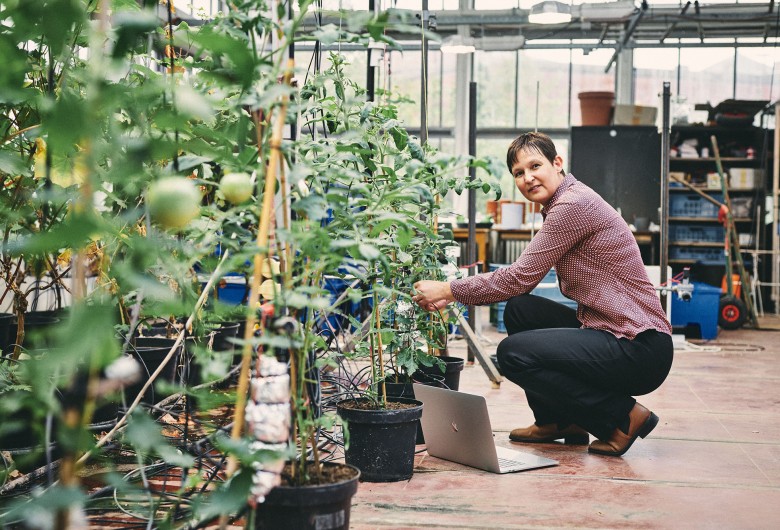
“Most people water their plants too much. Or too little. Knowing exactly how much water to give them is not easy,” says Professor Kathy Steppe. She uses sensors to meticulously measure when plants need water and how much.
Kathy Steppe graduated in 2000 as a bioengineer. She completed her doctorate in 2004 and became a professor at the Faculty of Bioscience Engineering in 2008. There, she heads the Plant Ecology lab.
Building biospheres was supported by the Societal Value Creation Fund of Ghent University.
Read also
Researchers from Ghent University in Antarctica: unearthing the secrets of the southern continent
How do microorganisms in polar regions respond to change and what does this teach us in the fight against global warming? For many years, this question has occupied biologist Bjorn Tytgat and the team he is a part of.

Optimism as a driver of change: honorary doctorate for Christiana Figueres
Ghent University is awarding an honorary doctorate to Christiana Figueres for her tireless commitment to climate action and her unique ability to unite people and nations around a common goal. She has turned her stubborn optimism into a lifestyle.

Understanding the impact of climate change? Measure, measure and measure again!
“Climate change is a global problem. But if you really want to know its impact, you have to have local data.” So say meteorologist Steven Caluwaerts and bioengineer Pieter De Frenne. They both do research on microclimates, albeit with a different starting point. “Actually, we are very complementary. We should meet more often!”

Climate tower in Congo fills a big gap in our knowledge
Deep in the Congolese rainforest stands a tower 57 metres high that is helping in the fight against climate change. Since October 2020, the Ghent University climate tower has been measuring both the amount of CO2 captured and stored by the tropical rainforest and the levels of water exchange between the forest and the atmosphere.
